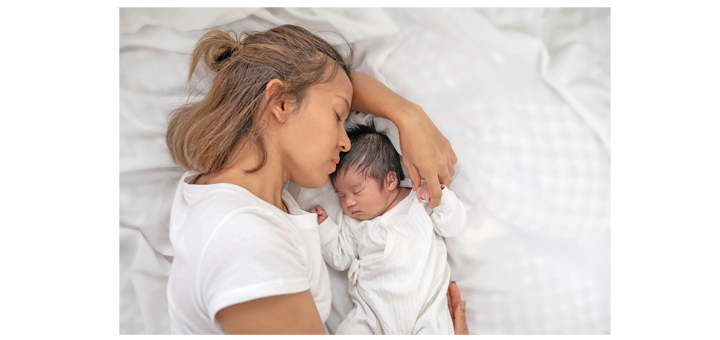
For most of human history, there was no question as to where and how an infant would sleep in the weeks and months after their birth. The importance of the constant protective contact and accessibility of the mother for breastfeeding was so historically necessary for survival that to suggest an alternative would have been neglectful. Therefore, adult humans in many different cultures and in different eras have, like all mammals, universally slept with their babies.
And, yet, “co-sleeping” is a very controversial topic now-a-days. The American Academy of Pediatrics guides parents against sleeping with their infants. Parents are fearful of the practice because they have been taught of its dangers. Mothers who would be drawn to co-sleeping are afraid that they will be judged and challenged by the child protection services. There is a cultural trend that values independence over nurturing, which guides families to encourage infants to sleep alone as soon as possible.
But research has shown, when specific guidelines are followed, that co-sleeping is as safe and, in some cases, safer than crib sleeping. For example, cases of SIDS are half as likely when baby is sleeping with his or her parent. Research has also demonstrated the benefits of bodily contact and proximity of parent to baby for the baby’s safety, successful sleeping patterns, and emotional, psychological, and neurological development.
Dr. James McKenna, the former director of the Mother-Baby Behavioral Sleep Laboratory at the University of Notre Dame, spent 30 years researching co-sleeping and demonstrating the special abilities of low and high-risk mothers to respond to their infants’ needs while bedsharing.
Dr. McKenna’s research also demonstrates the significant neurological development that occurs during sleep hours, showing a measurable difference of brain activity depending on level of maternal-infant contact and interactions. He argues that proximity to the parent and direct physical contact directly affects the intellectual, emotional and psychological growth of our babies’ brains. Dr. McKenna asserts that depriving infants of this important stimulation, especially during sleeping hours, can affect their intelligence and emotional stability long-term.
We can also look at the issue through the infant’s eyes. Don’t we intuitively know that our babies sleep deeply and for long stretches when they are next to our warmth and smell and voices? How many times do we hear a new mother say, “The baby sleeps fine when she is being held!” Why do we fight this common phenomenon? What are ways that we can promote our babies’ natural instincts for being secure while making that environment safe for us to sleep with them as well?
There are certain situations, with certain individuals, in which bedsharing is not appropriate or safe. For example, if parents are smokers or if alcohol in any amount is consumed, co-sleeping should not be practiced. Other precautions include: removing heavy blankets and pillows, having a firm mattress, making sure the bed is not pushed up against the wall, and others. Dr. McKenna lists these protocols, and others, in his book. He also compassionately recognizes the complexity of the decision: how comfortable each parent feels, whether the family will get any sleep, how will it affect the child’s ability to be independent, how it impacts the couple’s intimacy, etc. What wonderful and useful issues to contemplate!
In my own practice, I love having this sleeping discussion with my clients. I ask them what they feel comfortable with. I describe to them the acute awareness of their newborn that is innate to every new parent, even adults who consider themselves deep sleepers. I expose them to the current research and to the testimonies of experienced families. I encourage them not to make decisions out of fear or anxiety, but out of an understanding of the pros and cons of different options. Together, we discuss real-life scenarios. I suggest they have a bassinette in their room. I also itemize the safety preparations in case they decide to co-sleep or in case, without meaning to, mom and the baby end up falling asleep together after a nursing session.
Often, for most parents, it is a combination of both modalities – crib sleeping and co-sleeping – that works, depending on the frequency of the baby’s feedings, depending on what part of the night it is, depending on what is allowing the most uninterrupted sleep. And this brings us back to a basic principle of parental autonomy and flexibility: using our intellect, historical knowledge, intuition, and observation skills to make the best decisions for our children and our family and letting these methods change if the conditions change. ■
Recent Stories
-
Free Summer Eats Meal Program Returns to Springfield to Keep Kids and Teens Nourished All Summer Long
With the school year having ended on June 23rd, Chartwell K12, Springfield Public Schools, and Home Grown Springfield are helping ensure that no child goes hungry this summer through the Summer Eats Free Meals Program.


Upcoming Events
[tribe_events view=”photo” tribe-bar=”false” events_per_page=”2″]
Af-Am Point of View Recent Issues
August 2026

July 2026

June 2026

May 2026

See More Past Issues of Af-Am Point of View Newsmagazine