President Trump announced that April 15, 2025, would be remembered in American history as Liberation Day. In his speech and subsequent statements, ‘Liberation Day’ symbolizes the day America took control of its economy and imposed tariffs on foreign products—especially those from countries with which the United States had a trade deficit. Since that announcement, President Trump has used tariff powers without Congressional approval, effectively shaping foreign economic policies. Additionally, the imposition of tariffs has been disorderly, often announced via social media posts, and has fluctuated over days and weeks, leaving exporters, importers, and consumers little time to adjust. Besides affecting consumer affordability, this centralization of authority weakens the powers granted to legislators, challenges the principles of international treaty-making established by the Founding Fathers, and conflicts with international law.
Our Constitution, under Article I, Section 8, Clause 3, grants Congress the authority to regulate commerce with foreign nations. It also gives the President treaty-making powers that require the advice and consent of the Senate, with a two-thirds majority. However, Presidents often impose tariffs citing broad statutory delegations, such as sections 232 (national security) and 301 (unfair trade practices). One of these delegations was formalized under the International Emergency Economic Powers Act (IEEPA), passed in 1977, which grants the President extensive economic authority. The Administration stated that its tariffs are intended to address the ‘unusual and extraordinary threat’ of illicit drugs and trade imbalances. The phrase ‘unusual and extraordinary threat’ triggers the IEEPA; however, the Trump administration’s application is too broad.
Initially, the Administration has imposed import tariffs not only on traditionally regarded enemy states like North Korea and Iran but also on longtime allies such as Canada and the European Union. Considering the geopolitical history of the IEEPA and the timing of its enactment, the Act was designed to reduce and eventually eliminate reliance on an enemy state, Iran, and later Iraq, during George Bush’s presidency. Today, however, the Administration uses its powers to generate revenue and to weaken the post-World War II framework that shifted the global economy toward free trade, lowering or removing tariffs and non-tariff barriers across various sectors. Keep in mind, the Trump Administration is not the only one that weakened the World Trade Organization (WTO). President Obama and Biden blocked the appointment of judges to the WTO Appellate Body. Nonetheless, the current Administration’s efforts go beyond the actions or inactions of its predecessors and seek to overhaul the global order from a rule-based system to a system of absolute power.
So, what’s next? On Nov. 5th, the Supreme Court heard oral arguments challenging the legality of Trump’s tariffs. The Court’s decision will have significant implications for the separation of powers, the government budget, and the global economy. From a practical standpoint, the Court asked what would happen if it ruled against the administration. It will be a mess, as Justice Barrett noted during the oral argument. A ruling against would nudge the Administration to pursue a rule-based global economy. ■

Recent Stories
-
Free Summer Eats Meal Program Returns to Springfield to Keep Kids and Teens Nourished All Summer Long
With the school year having ended on June 23rd, Chartwell K12, Springfield Public Schools, and Home Grown Springfield are helping ensure that no child goes hungry this summer through the Summer Eats Free Meals Program.

Upcoming Events
[tribe_events view=”photo” tribe-bar=”false” events_per_page=”2″]
Af-Am Point of View Recent Issues
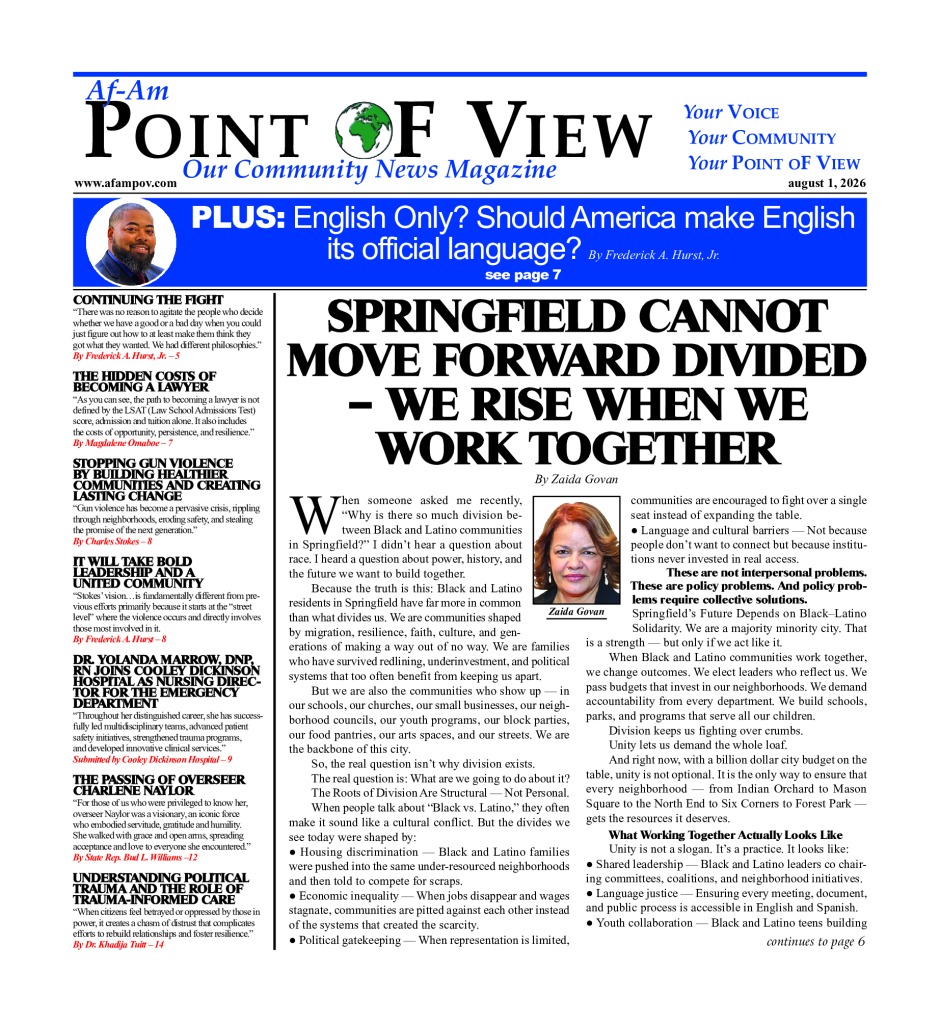
August 2026
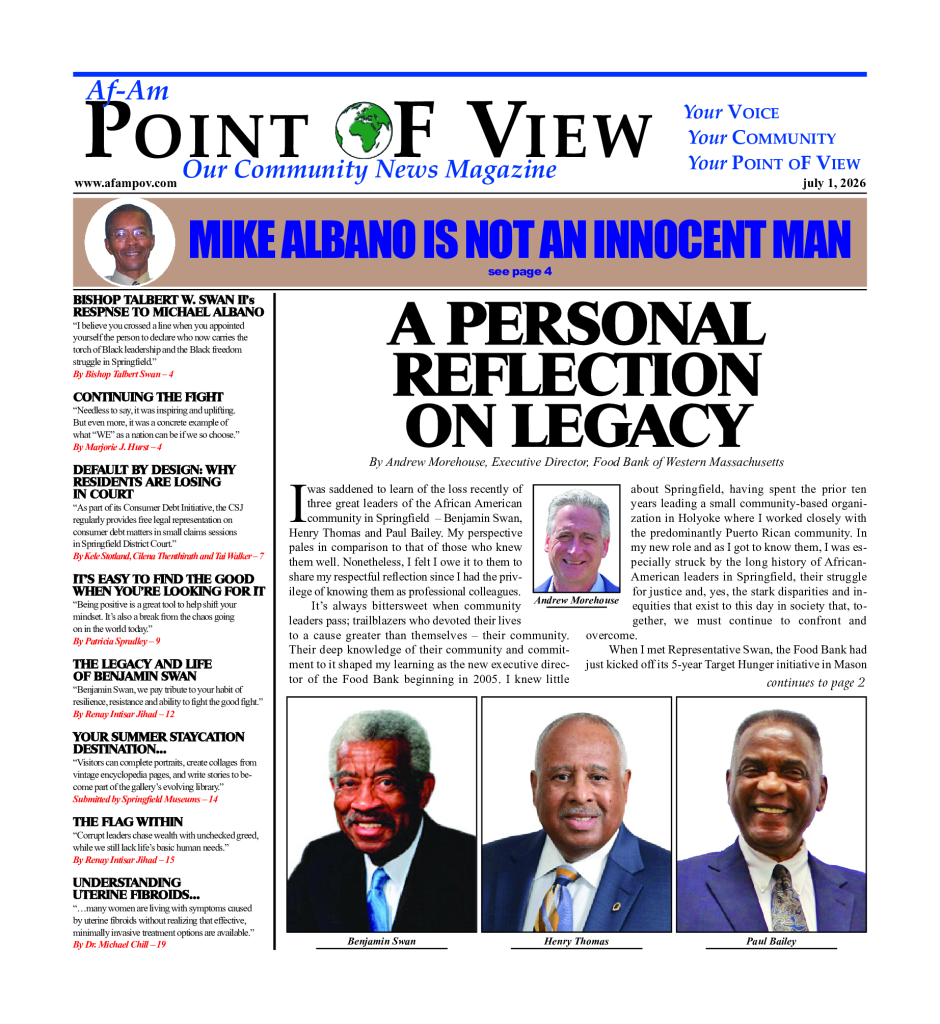
July 2026
June 2026
May 2026
See More Past Issues of Af-Am Point of View Newsmagazine