State Representative Bud Williams is an old friend of mine. In the past, we were warriors in the lonely foxholes of frustration together in Springfield, Massachusetts’ political wars in an effort to open up some of the barriers to the “actual” political power that only a few in Springfield enjoyed.
Our battles started in the late nineteen-sixties and continued up to the beginning of the next century. Bud was about half a decade younger than me when I returned to Springfield in 1968 with a bachelor’s degree from Howard University in Washington, D.C. shortly after Dr. Martin Luther King Jr.’s untimely assassination.
I returned angry at King’s assassination, infused with the philosophy of the Black Power Movement and determined to influence and organize the younger Black folks of Springfield with the help of many of my own contemporaries. Bud was among those young people and nearly a contemporary, and although I didn’t know him that well, he knew me.
Bud was remotely involved in my 1969 run for mayor and was actively involved in my 1975 (or thereabouts) run for city council. A few years after the council race, I left for a job in Chicago and when I returned to Springfield in 1980 with a law degree and began practicing criminal law, Bud (who worked in the court house as a probation officer) relentlessly pressed me to get reinvolved in Springfield politics, which I seriously did not want to do.
Bud prevailed and we went to war against an almost hopelessly locked up status quo that considered it a sacred right to choose who should be “in,” politically and economically and who should be “out.” And we were out. So, we decided to fight for a new order, which I naively predicted would take only six years (to take the mayor’s office, mind you!).
We started with the late Mo (Morris) Jones, who had lost a previous race for city council that Bud had managed. We won against all odds but Mo did what Mo had always wanted to do and joined the status quo, which included the late Ray Jordan who was the sole representative of the Black community who White folks recognized as its only meaningful leader. So, we ran Marjorie Hurst for school committee.
Although we all worked hard for Marjorie as she did for herself, she came in fifth, one place short of the winning four, partly because Ray Jordan did not want a Hurst in office and worked to defeat her.
And, after a very public political brawl, which began when one of the sitting school committee members won a city council seat and resigned from the school Committee, Marjorie failed in an effort to replace him when she lost a combined vote of the school committee and city council.
(Unlike now, back then a vacancy was filled by a combined vote of the city council and school committee. Although Marjorie won all of the school committee votes, she missed winning enough council votes by one vote. The late City Councilor Mo (Morris) Jones and then City Council President Frank Keogh, at the request of Ray Jordan, maneuvered the council vote against her.)
We next ran Bud L. Williams (formerly referred to as Buddy Lee Williams) for city council and after four efforts, he won.
And that’s when I first sensed a change in our heretofore solid relationship. And things went down from there. It serves nobody’s interest for me to go into a lot of the painful details. Suffice it to say that Bud was happy with his new role and after a while, I was not.
So, we parted ways after decades of running up and down Boston Road in any kind of weather every morning planning how we would counter political attacks and protect the economic progress we had made, which brings up the point of why I do not believe Bud Williams’ challengers will defeat him.
The daunting political fact that any challenger must overcome is that Bud enjoys the benefits of history, personally and politically. And the only way for a challenger to defeat him is to work extra hard – not just harder than Bud but much, much harder.
Bud was extremely well known long before he entered the political realm. He was born and raised in a one-parent household in the North End until his struggling mother moved the family to Mason Square. (Bud’s father died young from natural causes.)
Bud was, essentially, a savvy street kid who roamed the streets of Springfield, spent much of his time at the Boys Club, and as a high school basketball star, and even more of his time making a street “rep” as a basketball player at DeBerry School playground and other venues.
Bud knew poverty and rose above his humble beginnings while making enough close friends in the Black community to last him a lifetime, and many in the White community, including the likes of Congressman Richie Neal and many other once equally struggling Irish and Italian politicians.
To top things off, he was raised in the church and remains a staunch church-goer. He and his wife, Dr. Gloria Williams, raised two kids together and even now, are raising grandkids together. Bud also earned his Bachelors and Master’s Degrees and has a rich employment and entrepreneurial history.
I think even Bud’s most skeptical detractors must admit that few who have challenged him in politics can match his combined personal and political histories. There are many with similar histories both among those who have challenged Bud and the many who won’t dare. But few can match the range and scope of his experiences.
Bud’s political history began as a close associate of the late State Representative Ray Jordan. They parted ways but Bud maintained close ties with the Irish politicians who associated with them. He ran Mo Jones’ campaigns, participated in all of Marjorie Hurst’s early campaigns, and the campaigns of other Ray Jordan challengers including that of Carolyn Hurst McDonald (my sister), a novice politician who almost defeated Ray.
(Few knew that Bud and I also helped the late Ben Swan get elected in his race to replace Ray Jordan as State Representative (not even Ben Swan) by convincing the reluctant-to-get-involved late president of The Republican to endorse Ben over Ray’s chosen replacement. Ben won by a single digit margin – either 3 or 7 votes.)
And, finally, Bud ran for city council, served several terms as its president and when the opportunity presented itself, he soundly defeated his challenger for the retired Ben Swan’s seat where he remains comfortably ensconced to this day.
Ironically, the only person to challenge Ben Swan during his time as State Representative was Bud L. Williams while Bud has faced and (to his credit) defeated many challengers. And I’ve had the opportunity to engage most of them. And, I’ve delivered the same message which is “start early,” “work hard,” and “fight.”
I cannot remember any one of Bud’s challengers who “started early.” And I can remember only one who worked “hard” (Johnny Ray McKnight). And even he didn’t work as hard as he should have. (Needless to say, if you don’t start early, you cannot claim to have worked as hard as you should have no matter how hard you worked.) What was clear in the last race was that McKnight benefited mostly from the fact that Bud hardly worked at all, which certainly will not be the case in September’s election.
By “fight,” I mean a political brawl! You cannot dance your way to a victory against an incumbent whom you’re displeased with! Voters want to know the “why” of your displeasure and they want to know what you would do better and how. And they want to know your personal and political history and the substance of your claim to be a better choice than the incumbent. And even more, they want to be assured that you are unafraid to speak truth to power (a test that at least two of the three challengers have already wimped out on in writing.)
And one thing I can assure you of, Bud Williams can fight. The only question is whether or not he will fight. And I must admit, after observing all of his contenders over the years and the passive behavior of the folks who served before and since he became a state rep – those who were on the council and are on the council and in the state house, and those who intend to run against him this time – I’ve reconsidered my own prior judgment. Bud (with the exception of Raymond Jordan, Justin Hurst and a few others) stands out among them all even in his worst moments.
Which is why I finally called Bud and he and I had a long discussion and agreed that it is important for the good of Springfield and of the Black community that we get past our differences and focus on the needs of the future and, especially, the future of those who will follow us.
Bud and I have always been civil with each other. But I remained disappointed that after a history of sometimes brutal struggle to get there, he appeared to become relatively passive in his city council job after an admirable start and in his current state representative job. I expected more of him, which is why I went my way and he went his.
But as of now, that is all in the past partly because I’ve come to appreciate the inflexibility of Massachusetts’ state politics in which survival is almost absolutely conditioned on compliance where a few actually control and rule and the others are rewarded for following. Independent behavior is such a rarity that no one, it seems, in the Hamden County delegation, in my opinion, can lay claim to it, White, Hispanic or Black, which is a disappointing reality that suggests that I and others have judged Bud Williams too harshly by holding him to an impossible standard that none of his colleagues hold themselves to. I now personally believe that we critics of Bud Williams’ performance can be more influential with him as his supportive confidants rather than as public critics.
And I’m sure he understands that we will continue to hold him to account as he should hold us as voters to account as we all try to work out problems together as a more united community of experienced professionals who want to leave a meaningful legacy and who want to allow the Springfield Black community to have a meaningful opportunity at realizing its, heretofore, elusive political legacy.
It is certain that we have not gotten there by historically dividing our own votes. And as far as I’m concerned, we won’t get there by dividing our votes four different ways among Bud and his three Black challengers, who are hampered by the fact that the three will likely cancel each other out and Bud will most likely win anyway.
Needless to say, the current political condition of Springfield’s Black community gives new meaning to the old saying about there being strength in unity and an alarming urgency to the well-known Biblical message that a house divided will not stand, which is why I’ve urged Bud and Justin Hurst to work more closely together to break the historical mold that has kept our community so divided that the best of our political destiny remains unrealized.
All that having been said, for the first time in the many elections in which we made no overt endorsements for Bud’s state representative position, we at Point of View endorse Bud Williams for State Representative for the 11th Hampden District and urge others to vote for him in the September election. ■
Recent Stories
-
Free Summer Eats Meal Program Returns to Springfield to Keep Kids and Teens Nourished All Summer Long
With the school year having ended on June 23rd, Chartwell K12, Springfield Public Schools, and Home Grown Springfield are helping ensure that no child goes hungry this summer through the Summer Eats Free Meals Program.


Upcoming Events
[tribe_events view=”photo” tribe-bar=”false” events_per_page=”2″]
Af-Am Point of View Recent Issues
August 2026
July 2026
June 2026
May 2026
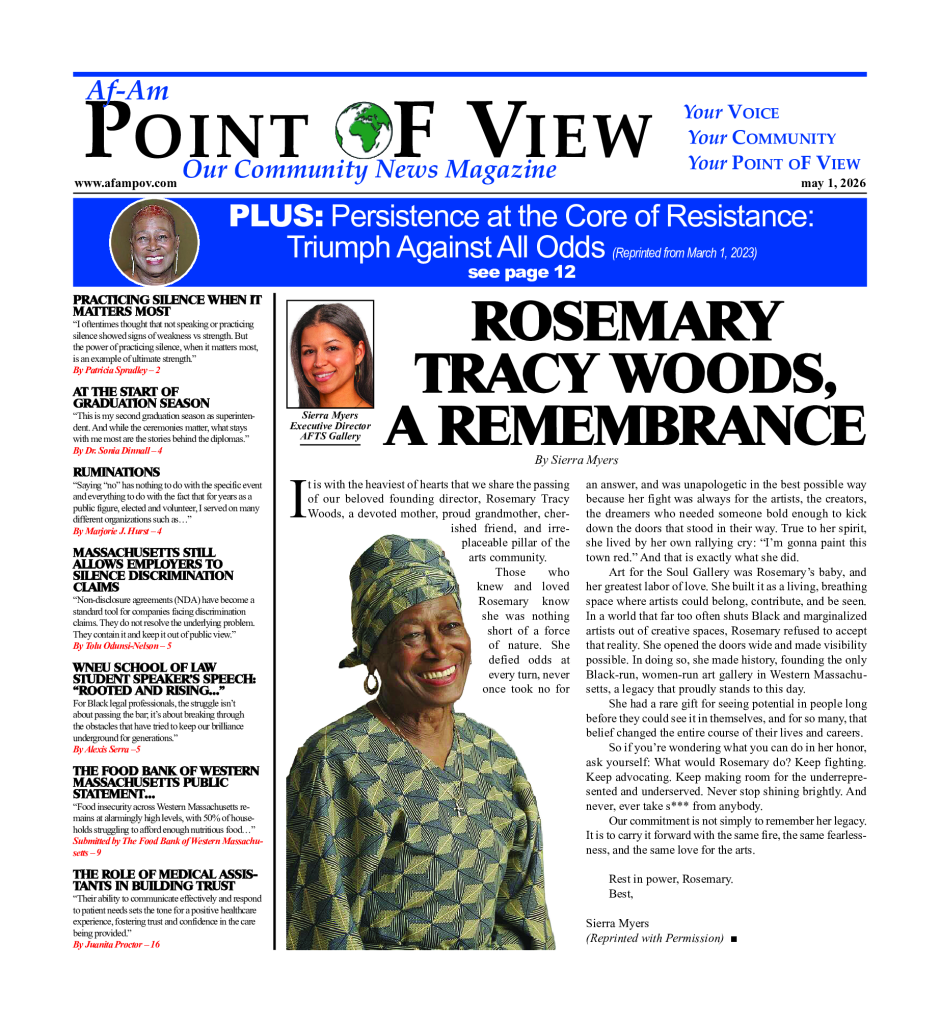
See More Past Issues of Af-Am Point of View Newsmagazine