
I Learned Public Service from the Best!
A FATHER’S DAY TRIBUTE
— by Helen R. Caulton Harris Commissioner, Springfield Department of Health and Human Services —

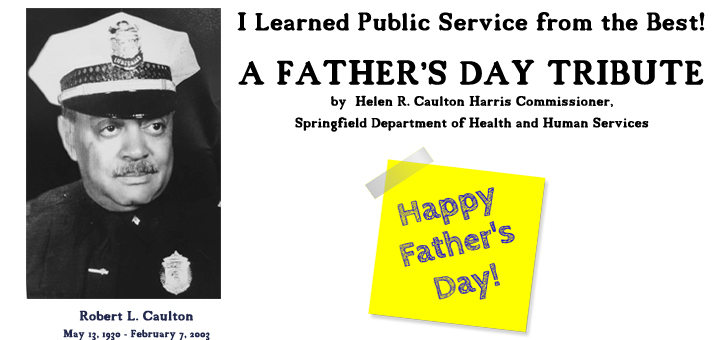
May 13, 1930 – February 7, 2003
My great-grandparents, Charles and Helen (Moses) Caulton, were sharecroppers from Moultrie, Georgia, who came to Springfield in 1920 along with their three children, Sunnie, Alberta and Vessie. In 1927, Sunnie Caulton married my grandmother, Dorothy Mittens, born in Springfield in 1910, and they settled in the North End. My father, Robert L. Caulton, born May 13, 1930, was the second of their eight children. My father was one of only six black men as of 2007, who had worn the badge of Springfield police Lieutenant. He also passed the Captain’s exam. I learned public service from the best! My father was educated at Hooker Elementary, Chestnut Junior High and Technical High schools during the 40s. A superb athlete, he earned the nicknames “Speed” and “Spider.” It was as an athlete at Technical High School that my father encountered overt discrimination. Most of the black athletes were not allowed to start on the teams although they were the superior players. It was painful for my father to watch white players with less talent start ahead of him. It was then that my father really learned the lesson my great-grandparents preached: “You have to work harder and be twice as good to get the same distance because you are a black man.” But my father was able to play football, basketball and baseball in his North End neighborhood with the North End Crusaders, coached by Trigger Josey. My father worked at Chapman Valve and my mother hand-stitched baseballs at Spalding. I was entrusted into the care of my great-grandmother, Helen. My parents moved from the North End when I was 7. Always an ambitious man, my father once asked a white supervisor at Chapman Valve about the prospect of a promotion. He told my father “a laborer in the foundry was the best he could expect as a black man.” That answer would change the trajectory of my father’s life. James Davis, a black police officer who would become Captain, lived across from us on College Street and encouraged my father to take the police exam. My father was appointed a Springfield police officer during the height of the Civil Rights movement in 1964. My father would later recall that time as one of the most conflicted periods of his life. While family members marched and were arrested as civil rights workers, my father stood opposite them in uniform and riot gear. In 1974, daddy suffered a severe stress attack and was told his days as a police officer were over. But not only did he go back to the job, my father spent the next 18 years studying and successfully achieving rank. In 1992, at age 62, he would go before the Police Commission for the last time to be promoted to Captain. My father went in full of confidence, after all for the first time in history a Latina, Millie Rivas, was on the Commission and an African American male, Henry Thomas III, was the Chair of the five member Commission. My father was not selected for promotion despite being the most qualified candidate. In the weeks to follow, my brother Mark and I were informed that neither Ms. Rivas nor Mr. Thomas voted for our father. When the ball was in my father’s hands, he did exactly what the ancestors required. He advanced his family, and, therefore, the black race and refused to allow failure define his life. When he died on Feb. 7, 2003, he was secure in the knowledge he left a strong team on the field. ■