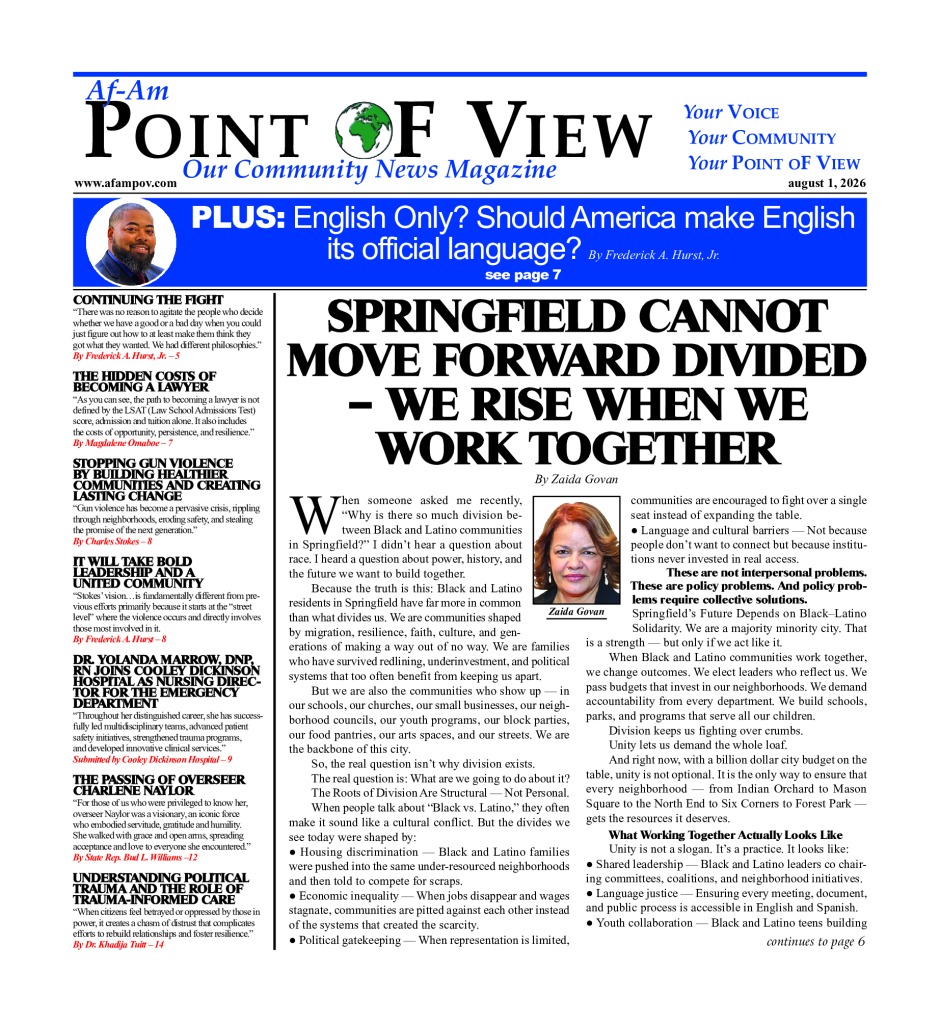

LATONIA NAYLOR
I mistakenly wrote in last month’s Bits that “no other candidate on the ballot” other than Justin and Denise Hurst received more than 6,000 votes. LaTonia Naylor also broke 6,000 in her win for the Springfield School Committee.
IT NEVER PAYS TO PUT YOUR HEAD IN THE SAND
It’s an ancient saying that holds true to this day: It never pays to stick your head in the sand to avoid recognizing and solving a problem. And State Representative Bud Williams might be wishing he had heeded these wise words of caution as he ignored his aide’s electoral misbehavior for years instead of reining him in and teaching him responsibility for the law and ethical and moral accountability. Now, as a consequence, Bud is facing the very real possibility of a challenge from Jynai McDonald in this year’s upcoming 11th Hampden District state representative race while his aide, Malo Brown, runs around declaring himself the absolute leader of the Black community although he barely won the Ward 4 City Council election against Jynai McDonald by unprecedented law breaking and deceit.
JYNAI MCDONALD IS THE QUINTESSENTIAL, INDEFATIGABLE WARRIOR
I give Jynai McDonald an enormous amount of credit for her willingness to remain in politics without being discouraged by her two city council losses to Malo Brown, who was recently required to give up $1,000 of his campaign funds for violating election fundraising laws as a result of a complaint filed by Jynai McDonald with the state Ethics Commission. Jynai has complaints pending against Malo with the Massachusetts Attorney General and the Secretary of State and, most recently, with the Hamden County Superior Court requesting that the election she lost by a small margin be overturned for Brown’s many election violations. Whether or not she prevails in legal forums, Jynai will always be recognized as a tireless and fierce competitor. And, she is not finished. (see below)
NEWS RELEASE: “COMMUNITY ACTIVIST JYNAI MCDONALD SERIOUSLY
CONSIDERS CHALLENGING STATE
REPRESENTATIVE BUD WILLIAMS”
“I plan to be in conversation with my loved ones and supporters for their input before I make a formal decision (by January 17th). I recognize that many people in the 11th Hampden District are tired of the same old run of the mill politics that have yielded little to no results for the community and are ready for a change in leadership.” Jynai goes on to say: “The egregious behavior displayed by Representative (Bud) Williams’ Chief of Staff, which led to me contesting the November election, is an indictment on the representative’s ability to lead during these difficult times. The enabling of this behavior by Representative Williams has no place in politics and is a detriment to the 11th Hampden District. We are in desperate need of bold leadership with innovative ideas that benefit the entire district and, under the current leadership, there is an obvious void.” (Jynai is right, of course. And I might add that it is not only behavior that is “egregious” or a “detriment” but it is also behavior that is a substantial and gross embarrassment to the community. We can do better. Run, Jynai, run!)
BUD PRESSES THE PANIC BUTTON
Just a bit of background information. Though I haven’t been able to confirm it, the rumor in the political community is that Bud Williams, upon hearing the news of Jynai McDonald’s potential run for his seat, panicked and called the governor’s office to have Jynai removed from her trustee position at STCC, asked Speaker of the House Mariano to help him with fund raising and contacted Jynai McDonald’s employer to have her terminated. Now, do I believe Bud Williams would resort to such cheap and lowly tactics? I do. Do I believe he will be successful? I don’t. The power he claims to have has always been more illusory than real. Do I believe Jynai McDonald can defeat Bud Williams in a head-to-head race for the 11th Hampden District State Representative seat? I do. She is honest and is most concerned for the people. Bud is considerably less than honest and is most concerned for Bud. If Jynai does her homework and her footwork, she will beat Bud. That is my prediction for the New Year.
“MASSACHUSETTS IS FAILING TO GROW MARIJUANA INDUSTRY EQUITABLY”
The above title is the headline of a November15, 2021 Boston Globe editorial which came out just a month and a half after I wrote my September 2021 front-page article (“Marijuana Legalization: I Was Wrong”) decrying the direction marijuana legalization had taken. I was not complimentary and shortly thereafter a slew of reports came out praising the success of the legalized marijuana industry mostly relating to the billions that were being made from sales and none relating to the problems I raised in my article…until the above referenced Globe editorial. It stated: “From the business side…, the laws that legalized marijuana in the state have yet to fulfill their promise. Though the industry has delivered thousands of jobs and billions of dollars in revenue to Massachusetts, its current regulation has been plagued with corruption and has created barriers to entry for small businesses. And though the state established a social equity program that aims to help people of color – who were most negatively impacted by criminalization of marijuana and the war on drugs – start-up businesses in the industry, just about 8 percent of companies that have opened marijuana facilities are owned by people who participated in the state’s social equity program…, lawmakers have not updated the rules and regulations that govern the marijuana economy, in spite of local corruption over licensing and new evidence that shows the state moving toward market domination by big companies rather than a competitive environment…. If Massachusetts wants to ensure that it protects consumers from predatory business practices, fosters a competitive environment for small businesses, and roots out corruption, then it has to be more proactive in passing regulatory measures that allow the market to grow responsibly….To start, the state should overhaul its local approval process, which has given cities and towns too much control over which businesses can or can’t open….Not only has this been a recipe for petty corruption…but it has also made opening up marijuana businesses a much more expensive endeavor than it has to be.” (emphasis added.) (Note how many times the Globe article uses the term “corruption” as you review my below bit on the report of Springfield’s audit of its process for awarding marijuana licenses. I also use the descriptive term “corruption” many times…and for good reason.) WHAT (THE AUDITOR) FOUND: AN AUDIT OF SPRINGFIELD’S MARIJUANA COMPANY SELECTION PROCESS
The audit findings below were a result of an internal audit demanded by Springfield City Councilor Justin Hurst, chair of the Council Audit Committee. The audit was conducted by the City’s internal auditor. Although the results were unnecessarily delayed by the city’s legal department, they were eventually released to the council and are available to the public. I’ve commented below only on the four summary findings of the audit after listing each in numerical order as follows:
1. There were errors in the tallying of scores of Applicants during Phase 2, resulting in an erroneous score for an Applicant who potentially would have been awarded a host community agreement had it not been for the erroneous score.
(Point of View has been trying to find out who the left out applicant is without any results. What we know from the report is that the left out applicant actually came in 5th but ended up in 7th place and the applicant who would have been 7th and out of contention ended up in 6th place. We also know that the 6th place winner who would have finished 7th and out of the running was one of the most favored, wealthy businessmen in Springfield. The auditor called it an “error.” We would rather have the attorney general and the cannabis commission characterize it after a careful scrutiny of the facts, since there are so many other words that could also describe it, i.e. “corruption.”)
2. “A marijuana transportation company applicant during Phase 2 was awarded a host community agreement despite its noncompliance with the City’s marijuana zoning ordinance.”
(Our understanding is that the Request for Proposals (RFP) that the public received and that all applicants responded to included a requirement that the marijuana zoning ordinance was a strict requirement. If it was only a “suggestion” or meant for only some applicants and not others, we would like a better explanation for the oversight other than the one given by the city solicitor to the council which was that the mayor had the authority to override his own RFP. It seems to us that the RFP as released to the public was not just faulty and misleading but also legally deficient since it discouraged any others who might not have responded to it because they didn’t meet the zoning ordinance requirement as articulated in the RFP. If nothing else, someone apart from the mayor’s lawyer and much more neutral should examine the matter a bit more objectively, i.e. the attorney general and/or the cannabis commission. Without uniformity in the process, how do we avoid corruption or the appearance thereof?)
3. The composition of the Selection Committee to review cannabis company proposals during Phase 1 and Phase 2 did not comply with the City’s marijuana ordinance.
(First thing Mayor Domenic Sarno had to say when he announced the selections was that his review committee was absolutely open and objective. Both “open and objective” and out of compliance? We don’t get it. Something doesn’t pass the “smell test.”)
4. For Phase 1, critical documents, including Applicants’ score sheets, could not be located; and certain information provided could not be clarified by the Phase 1 Administrator, both of which resulted in a scope of limitation for our review of the Applicants’ scores.
(How convenient! Nobody from the public or relevant legal agencies can ever scrutinize the paperwork that the city is required by law to preserve because the paperwork is conveniently missing and information could “not be clarified.” If that is not a prescription for the presumption of corruption requiring an outside investigation, then I don’t know one.)
WHITE WOMEN VOTERS AND THE DISMANTLING OF DEMOCRACY
Renee Graham has outdone herself in her Boston Globe article about White women. (November 7, 2021). I would have never guessed. She wrote: “White women who vote Republican seek to maintain their privilege. This means voting against candidates who back policies that could alter the racial inequalities that keep the deck stacked in white supremacy’s favor. I’ve long suspected that some white people oppose legislation that would help all regardless of race because what they’re really against is anything that could erode their unearned power by leveling the field for historically disadvantaged groups….It’s why 63 percent of white Alabama women voted for Roy Moore, a Republican and accused sexual predator, when he unsuccessfully ran for Senate in 2017. It’s why only 31 percent of white women in Georgia voted for Reverend Raphael Warnock and Jon Ossoff, whose victories in that state’s two runoff elections this year gave Democrats a fragile majority in the Senate….Only twice since 1952 have a majority of white women voted for a Democratic presidential candidate – Lyndon Johnson in 1964 and Bill Clinton for his second term. Those are outliers. Though they won their elections, John F. Kennedy lost a majority of white women to Richard Nixon; Clinton lost that group to George H.W. Bush; Barack Obama lost it to John McCain and Mitt Romney….Some might be temporarily siphoned off for an election cycle, but they are nearly as stalwart to the GOP as Black women are to the Democratic Party….lies about the 2020 election, voter suppression, the erosion of reproductive rights, attacks on trans people, weren’t dealbreakers for white women in Virginia who voted Republican in Virginia on Election Day….Neither was placing the perilous state of our democracy under further control of those fixated on dismantling it. The only thing surprising about white women’s support for Republicans is that anyone is still surprised at all.”
POETIC JUSTICE
The Charlottesville, Virginia statue of southern confederate General Robert E. Lee was
torn down some time ago and recently auctioned off to new potential owners. The city received 6 proposals from arts groups, historical societies or individuals, some offering as much as $100,000 for the controversial statue but the Charlottesville City Council voted 4-0 to give it for free to the only local bidder: the Jefferson School African American Heritage Center who intends to melt it down and reuse the metal into “something beautiful and more reflective of our entire community’s social values.” How poetic. ■