
By Timothy Oppenheimer, Esquire
(Photo by Fred Schilling)
This topic is front and center again as a result of cases brought against Harvard and the University of North Carolina (UNC). A brief history of major affirmative action cases before the Supreme Court is in order:
Bakke (1978) – The main legal takeaway from this case is that a state school is prohibited from having racial quotas.
Gratz v. Bollinger (2003) – The University here added a specific number of points for an applicant who was an underrepresented minority. The Court found it impermissible for race to be the determinative factor in admissions.
Grutter v. Bollinger (2003) – Here the University used race as one of a number of factors in its admission process; race could not automatically result in admission or rejection under this plan. Rather, the University engaged, in the Court’s words, in a “highly individualized, holistic review of each applicant’s file, giving serious consideration to all the ways an applicant might contribute to a diverse educational environment.” On these bases, the Court allowed the program to stand.
Fisher v. University of Texas (2016) – Set out the following controlling Principles in assessing the constitutionality of a public university’s affirmative action program: (1) The University must show a compelling interest that justifies consideration of race in college admissions; the interest in obtaining “the educational benefits that flow from student body diversity” is such an interest; and (2) the use of race must be narrowly tailored to achieve this permissible goal, in that any “workable” and “available” “race-neutral alternatives” would not suffice.
This brings us to the Harvard and University of North Carolina cases presently before the Court. The former challenge is based upon the anti-discrimination provisions of Title VI of 19641, while the latter is based upon the 14th Amendment equal protection clause2 because Harvard is a private entity whereas North Carolina is a state university and the 14th Amendment applies only to state action. However, in prior cases the Court has used the same standards in finding a Title VI violation based on race as in finding an equal protection violation based on race.
Both schools contend they have complied with the requirements of Supreme Court precedent in their affirmative action programs. The plaintiffs, however, Students for Fair Admissions in both cases, seek to overrule that precedent and ban the use of race altogether, that is, to end affirmative action as we know it. What is their argument? First, they contend the history of the 14th Amendment does not support the use of race-conscious remedies; that racial classifications increase racial hostility, create conflict, and reinforce stereotypes; that explicit racial classifications “stimulate our society’s race consciousness”; and that the Grutter case tells universities they may use race if they call it diversity, whereas the Constitution “enshrines principles independent of social theories.”
The Court, plaintiffs assert, should “reaffirm the principle of racial neutrality in the Declaration of Independence, the Constitution, Title VI, and Brown v. Board of Education.”
UNC in its Brief to the Supreme Court argues that its admission process constitutes a holistic, individualized review of each applicant; that race may only occasionally tip the balance in favor of a Black applicant in their admission process; that Congress, soon after the adoption of the 14th Amendment in 1868, passed a number of race-conscious measures; and that “race conscious measures are consistent with Equal Protection when their very object is to break down the discrimination between Blacks and Whites.”
In the real world, UNC contends, “absolute colorblindness cannot be a universal principle.”
Is the Constitution colorblind? That has been the mantra of conservative justices for decades. This theory was advanced once again during oral argument in Merrill v. Milligan on October 4th, a case that seeks to eradicate what is left of the Voting Rights Act. The case involves a challenge to Alabama’s new Congressional district map, a flagrant racial gerrymander pursuant to which Blacks have the majority in just one of 7 districts although they make up 27% of the state’s population. The lower court threw out the map as a violation of the Voting Rights Act. Alabama argues that any consideration of race in redistricting violates residents’ equal protection rights, even if race is used to safeguard Black voters’ political power.
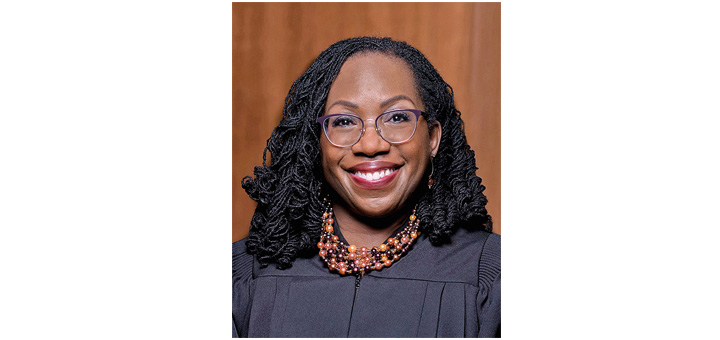
Justice Kentanji Brown Jackson proceeded to give a master class in Constitutional interpretation during oral argument, explaining by reference to the 1866 Report of the Joint Committee on Reconstruction, produced by the lawmakers who drafted the 14th Amendment, that “the entire point of the Amendment was to secure rights of the freed former slaves.” When she drills down to the actual history, she says, it becomes clear to her that the “Framers themselves adopted the equal protection clause … in a race conscious way,” that they were in fact trying to ensure that people who had been discriminated against, the Freedmen, were brought equal to everyone else in society. “So how could the Voting Rights Act’s race-conscious remedies possibly be unconstitutional?” she asks.
Will the Supreme Court say that all race-conscious remedies, unless in response to a specific finding of race-based discrimination, are unconstitutional? I do not have a crystal ball, but I agree with those who say that the Court has become just an arm of the Republican Party. ■
1Thus affirmative action and race-based preferences are being challenged as discriminatory, under the colorblind Constitution theory.
214th Amendment: No State shall deny to any person within its jurisdiction the equal protection of the laws.