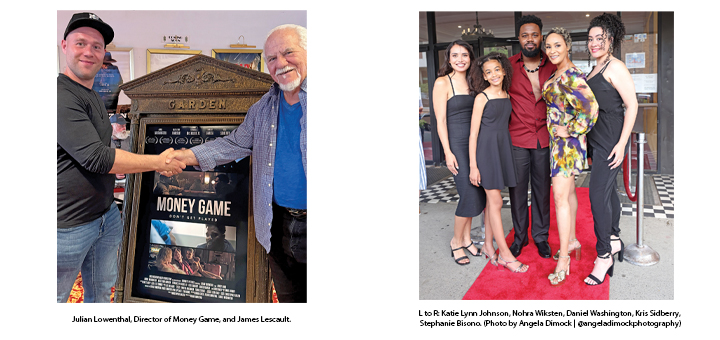

The first time I met filmmaker, Julian Lowenthal, was in the lobby of the Greenfield Gardens Cinema, Greenfield, MA, in June of this year, where he was having a showing of his first full-length feature film, Money Game. As of this writing, the film has won a dozen awards across three festivals, including Best Original Screenplay and Best Picture at the Boston International Film Festival. Worthy to note is that it was shot during the height of the COVID 19 pandemic and is relevant to the economic crisis that ensued.
I was invited to the screening by Lowenthal, via my husband, James Lescault, who met Lowenthal as a high school intern at Amherst Media. Jim was greeted with a handshake and huge hug from Lowenthal – who looked at me as he pointed to Jim and said to me: “This man helped me get here.” I’ve learned since that Lowenthal has been saying that about Jim to many people — it isn’t just a tribute to him, but the important role that independent media (which is often conflated with PBS) plays in the local and national communities — the last bastion of Free Speech in media.
The first day of shooting Money Game took place at Amherst Media. Lowenthal had asked Jim if he could use the studio, and told Jim it would it be about ten to fifteen people. Jim was delighted to welcome everyone to the Amherst Media studio and they set a date. Jim remembers the day with great fondness. “About thirty-five people showed up, cast and crew, all very professional, at our small community studio. It was Julian’s first day directing the project and it was quite a scene. A great day, and the shoot came in under time and budget.”
Julian Lowenthal was born in New York City in 1992, and lived there until his family moved to Amherst, MA, when he was “three or four years old” and considers himself to be, as he too humbly puts it, a “Masshole more than a New Yorker.”
I have to admit that when I first read the film’s title and knowing nothing about the film, my eyes rolled into the memory of Matthew McConaughey punching greed into his heart in “Wolf of Wall Street.” Please, not another screen load of white people problems and bad rich boy redemption — although the latter is touched upon — it is done well, as a cautionary moment—it isn’t what drives the film—the driving force is relatability for the average person and the importance of relationships over money.
Money Game, indeed has a heart, and it is clear from the opening moment that one is about to see a thoughtful and well-made film of high production value that opens with a familiar Western Massachusetts terrain: Turner’s Falls, where Lowenthal now lives. The diverse and impressive cast fully commit to every scene, and it is obvious from their stellar performances that Lowenthal, along with the cast, built not only an ensemble, but a community. The six lead actors (out of 38 total) are Daniel Washington; Katie Lynn Johnson; Terrance McFadden Jr; Naheem Garcia; Kris Sidberry; and Chris Owen. The writers are Brian Cheeks; Chris Galizio; Julian Lowenthal and Daniel Washington.
I knew as soon as I met Lowenthal that I wanted to interview him. His direct and honest gaze, his respect and celebration of all of his colleagues from the leads to the gaffers, and quiet confidence told me that this is indeed the kind of filmmaker we need to support and raise up in all of our U.S. media access centers. There are many out there for whom the prohibitive costs of film school are out of the question, but there is still a way for them to learn, flourish and create meaningful work in independent media access centers that are willing to do the work it takes to build the “access” part. “Back to School” isn’t the same for everyone.
MG: What is the first film you recall seeing as a child and what do you most remember about it? Do you recall how it made you feel? Where did you see it and who made it possible for you to view it?
JL: When I was 8 years old, I had the pleasure of spending two weeks in Lalita, Spain, where I stumbled on some of my father’s students watching the first Matrix movie in Spanish. Even though I couldn’t understand a lick of what was being said, I understood the story line through the wonderfully cinematic visuals. It made me feel like there was something more out there that I could learn to use to tell a very gripping and epic story. This scenario was only possible because my father is a Tai Chi teacher who would travel and do workshops. My brother and I were very lucky to be able to accompany him and my mother on most of these trips.
MG: When did you first realize you wanted to become a filmmaker – and who/what influenced you?
JL: When I was 12-years-old that’s when I really fell in love with cinema and wanted to spend the rest of my life being part of that world. At that time, I didn’t know I was dyslexic, but I did know I’d found a medium I could communicate through. My father was also a major influence as he was a screenwriter in the 70s and 80s. He didn’t like it, but his ability to write screenplays that got produced into feature films really motivated me to want to get into that field.
MG: Did you attend film school? If not, how did you begin to learn and develop your craft?
JL: I wanted to attend film school but I could never afford it, so every day after school (during my high school years) I would go to the local access TV station, Amherst Media, where I learned how to produce, direct, shoot and edit videos.
MG: As a director, who do you credit as your greatest influence(s) or role models in filmmaking and humanity?
JL: I have too many role models to list, but both my mother and father have been major influences. The Coen brothers were also major influences on me. Truth be told, every big and small filmmaker I came across has really influenced me, from Spielberg and Quentin Tarantino to Jordan Peele and many others. My role models in humanity, which I find different from filmmaking role models, would include my parents, Martin Luther King, Jr., Gandhi, The Dalai Lama, Rosa Parks and Abbie Hoffman.
MG: After viewing your first feature film, Money Game, I get the sense that you are committed to building community and mutual respect on the set – the bond of the cast is palpable and adds to the intimacy and relatability of the narrative and characters. How would you describe your directing style?
JL: I am very adamant about building a community. My goal is to eventually build a local film hub where artists from Western Mass to LA can come help each other to make riveting and entertaining films together. I would describe my directing style as one that’s very collaborative. Every project I do, I have a very vivid and clear vision of the story I want to tell. That being said, I feel that to tell the best story, it’s very important to collaborate with the team that you have put together. One person can accomplish a lot, but if a team of people work to accomplish that same goal, they can go miles further than you could ever have gone alone.
MG: Why did you choose Western Mass as your backdrop for the film? Where are some of your locations?
JL: As someone who spent the majority of my life in Western Mass, this is the area I know most. I know towns around Western Mass that could be an incredible backdrop for any genre of film. For Money Game, I always wanted to have it set in Franklin County and the Pioneer Valley as I feel that setting best represented the soul of what I was aiming for. We shot in five towns across Western Mass: Greenfield, Amherst, Millers Falls, South Deerfield and Turner’s Falls.
MG: You had a great cast to work with. Were you intentional about casting BIPOC actors, or was it all based on just auditions? Who was your casting director – and how did you work together? How far did you cast your net?
JL: The main actor, Daniel Washington, is an actor I’ve worked with on many films. I’ve always wanted to have him star in one of my projects and this seemed like the perfect fit. The cast organically grew from people I’ve worked with in the past, people Daniel has worked with, and several people neither of us have worked with that we auditioned and felt were perfect matches for their roles. Even though most of the casting was done by myself with the help of my producers, Brett Duffy was the casting director who helped us land Chris Owen. We all worked very well together and were able to put the best team together that we could. Even though the majority of the cast was from Massachusetts, we cast a pretty wide net and had several people from New York and Los Angeles.
MG: Did you know any of the cast and crew prior to making the film? Any friendship anecdotes for our readers?
JL: Besides Daniel Washington, I had also worked on several films with Terrance McFadden Jr. I’d worked with some others in the past, but most of them I met during the filming of Money Game. I definitely became close to all of the actors I’d worked with prior to hiring them for Money Game. A lot of the actors that I didn’t know until Money Game, I’ve now also become close to and plan to work with on many projects to come.
MG: Your cast were highly professional, talented, and not one was lost on screen. I can rarely retrace a film in its totality – but I have to say, I can recall every face and the journey of the story of Money Game. Where and how did you learn to create such a clear and cohesive storyline, where not a moment, scene or character are simply fillers? Even the “small” moments, like the Bryson character with his sycophants slobbering over him in a club, are crystal clear. You direct with the focus of a martial artist.
JL: I really appreciate the phrase “you direct with the focus of a martial artist.” I am a martial artist. I studied Tae Kwon Do from the ages of 8 to 18 and Tai Chi from age 12 to the present. I never realized, until that question, how much they played a major part in my directing style. I guess they have helped me overcome my dyslexia in obscure ways, which makes it easier to direct with a clear vision. I don’t believe in any small parts and a part of that could be from some of the many lessons I’ve learned in my martial arts background. Just because someone is quiet and reserved doesn’t mean they won’t land a punch on you if they’re tested.
MG: What do you want your films to elicit from your audiences? What human responses are you striving for? Are there certain principles about what it means to be human that you wish to project?
JL: I want to be careful answering this question as I want to let the audience get what they need to get from the film without me dictating my beliefs. That being said, my agenda has always been to present to everyone the most entertaining, engaging, empowering and educational film I possibly could. I want people to have a great time, while they get to walk out with a tool that they can use for the rest of their lives.
MG: What advice do you have for fledgling filmmakers?
JL: The best advice I can give anyone with any passion for anything is to never give up, to never quit and always go after what they love no matter what challenges or obstacles they may face. Sixteen is the age at which I began working on editing films and learning from the Amherst Media how to produce, direct, write and create videos. From the ages of 17- 22, I would apply to work on every film project I could find. At 22, I directed my first no-budget horror film. At 24, I made a professional career out of being a filmmaker. At 28, I embarked on directing, producing and writing my first seven-figure, union film.
MG: Where can our readers view your film and learn more about you?
JL: Our intention is to get Money Game into cinemas in various cities across the U.S. while distributing the streaming rights to several global platforms. To learn more about me or stay connected with my journey, I suggest following me on Instagram at @julianlowenthal or Money Game’s instagram @Moneygamefilm. I’m also very active on Facebook. If anyone wants to add or follow me, go to Julian Lowenthal.
I encourage our readers and aspiring filmmakers to follow Julian Lowenthal, see Money Game as soon as you can, and become inspired about your own journey, wherever it may call you. ■