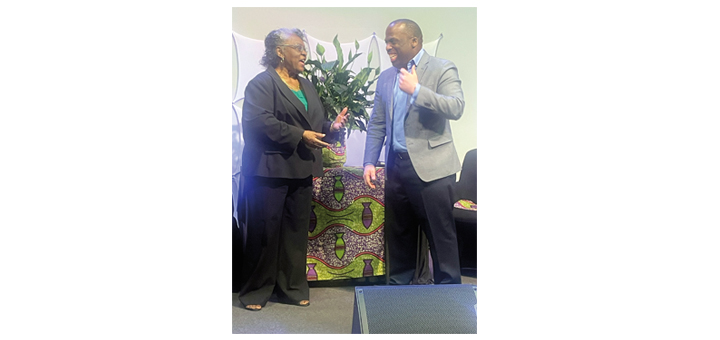

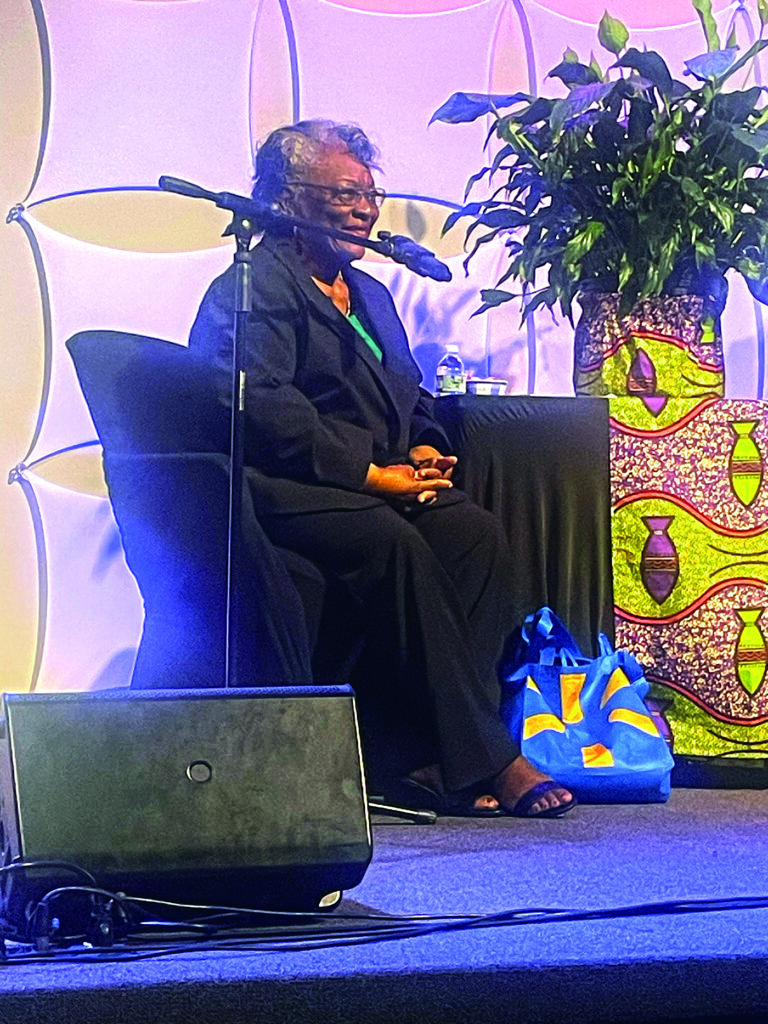
On Saturday, September 23rd, at Mt. Zion Baptist Church in Springfield, MA, an eager audience came out to hear Civil Rights Icon, Willie Pearl Mackey King, speak as part of a series of “Crucial Conversations” being hosted by Rev. Dr. Atu White and the church. This one was titled, “A Woman of the Movement.”
There’s something about reading about history in books—or at least there was—before this current movement began that is being spearheaded by the likes of Florida Governor Ron DeSantis to whitewash what is being taught in schools so as not to make white students uncomfortable about learning the truth. And there is something about watching documentaries that portray the events of history. But there’s nothing like hearing a firsthand account delivered by someone who not only witnessed that history but was an active participant in it.
Mrs. King took us on a journey from her birth on a farm in 1941 in a small town in Glenwood, GA with no indoor plumbing or electricity through her graduation from high school and move to Atlanta to find a job since there was no money for her to attend college and she had no plans of staying on that farm continuing to pick tobacco. As fate would have it, she ended up applying for a job at SCLC (the Southern Christian Leadership Conference).
One might think that being exposed to the environment of SCLC in the early 1960’s was what shaped Mrs. King into the passionate believer in civil rights that she became but an early experience of injustice she shared with us revealed that she instinctively reacted to unfairness and inequality as part of her moral compass even at a young age. She revealed that one of her first jobs was at a hospital where one of her coworkers had a heart attack and not one of the doctors or the nurses or any one of the medical staff would treat him. They just left him in laying on the floor and walked around him. This led to Mrs. King staging a walk-out and getting 13 other people to leave their jobs.
When she became the secretary for SCLC, Mrs. King was about 21. Her duties included making coffee for the group when traveling to board meetings in addition to typing. She shared how many times they were advised not to travel due to credible threats of violence. There was one time when they were driving along the highway and their car was boxed in by white men in pick-up trucks with shotguns in the back. She started crying and Dr. King said, “Don’t worry. Where’s your faith?” Ultimately, they were able to escape unharmed.
What stood out about Mrs. King’s stories of how Dr. King reacted to threats of violence and actual violence like the time he was attacked by a young Nazi who had brass knuckles between his fingers and jumped up on the stage and started punching him before he was pulled off. She said Dr. King’s response was, “We have to pray for him.”
When asked about Dr. King’s belief in nonviolence, she shared that Dr. King believed that nothing good comes from violence. “Nonviolence has to come from within you. The power has to come from God. If you don’t believe in nonviolence, it’s not going to work,” Dr. King advised her. Mrs. King shared many more firsthand accounts of being with Dr. King during those times and the prices that were paid by all of those who were fighting for equality.
However, her account of the part she played in typing Dr. King’s historic Letter from a Birmingham jail was probably the most captivating. She stated that Dr. King felt an urgency to get the letter out in response to the Alabama Clergymen’s Letter to him issuing “An Appeal for Law and Order and Common Sense” in dealing with racial problems in Alabama and urging that the Negro community withdraw their support of the demonstrations. It took her three days and nights straight to type the letter from what Dr. King wrote on edges of newspapers, scraps of paper and toilette paper that were smuggled out from the jail. She typed nonstop on an IBM selectric typewriter. She’s proud she had the opportunity to type the letter and has an original which that she holds dearly.
After her talk, the audience was invited to enjoy lunch and given an opportunity to ask more questions and take photos with Mrs. King. This first in a series of Critical Conversations to come was an enormous success. ■