Make the B7, G2, and B6 PVTA Bus Lines Free for the Next 2 Years as a Pilot Program
Sponsored by City Councilors Justin Hurst, Victor Davila, Tracye Whitfield, Zaida Govan and Kateri Walsh
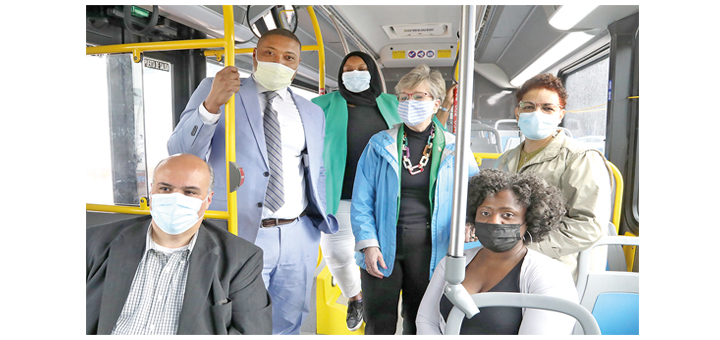
Why not free buses for Springfield residents as proposed by the five Springfield city councilors who rode one of the bus routes most traveled by those whose only access to necessary transportation is buses? Over 100 cities in the world (mostly in Europe) have some form of free transportation for the less fortunate among us. In Massachusetts, Boston and Lawrence experimented with the idea, first with one bus line, and both now have extended free busing to three of its busiest lines. Other Massachusetts cities are studying the matter, including Cambridge. But when the idea was proposed to Springfield’s mayor Domenic Sarno, he said it was not financially feasible. Other cities studied the matter, experimented and built on the success of their experiment. In other words, they found a way and so could Springfield in the same way it found millions to give to the rich to get richer. It appears that Sarno didn’t find a way because he didn’t bother to try.
Proposal:
Make the B7, G2, and B6 PVTA Bus Lines Free for the next 2 years as a Pilot Program with the ultimate goal of making public transportation in the City of Springfield free for all riders. The cost for this pilot program is roughly $1.7 million dollars per year and 3.4 million dollars over the course of the two years. The proposed source of funding for the pilot program would come from the American Rescue Plan Act Funding.
Data & Cost Breakdown:
Ridership Data (2019 Pre Covid):
Eastfield Mall via State State/Boston Road
● B7 Bus Line has the highest ridership in the City of Springfield
● This route is boarded 857,452 times Annually
● 100% of the People Riding the Bus Board in Springfield
● 100% of the People Riding the Bus Get Off in Springfield
● 100% of the Stops are in Springfield
● Total # of Stops on the Route are 90
● Total # of Stops in Springfield are 90
● Average Cost for Fare is $.96 cents
● Rough Cost for Ridership for the Entire Year is $823,153.92
Ridership Data (2019 Pre Covid):
East Springfield via Carew/Belmont-Dwight
● G2 Bus Line has the 3rd highest ridership in the City of Springfield
● This route is boarded 583,860 times Annually
● 96% of the People Riding the Bus Board in Springfield
● 95% of the People Riding the Bus Get Off in Springfield
● 90% of the Stops are in Springfield
● Total # of Stops on the Route are 154
● Total # of Stops in Springfield are 138
● Total # of Stops outside Springfield 16
● Average Cost for Fare is $.96 cents
● Rough Cost for Ridership for the Entire Year is: $560,505.60
● Rough Cost for Ridership for the Entire Year for Boards in Springfield Only: $536,941.44
● Rough Cost for Ridership for the Entire Year for Boards in East Longmeadow Only: $23,564.16
● Two of the Stops in East Longmeadow are a Nursing Home and Stop and Shop Grocery Store
Ridership Data (2019 Pre Covid):
Ludlow Via Bay Street
● B6 Bus Line has the 4th highest ridership in the City of Springfield
● This route is boarded 351,354 times Annually
● 93% of the People Riding the Bus Board in Springfield
● 92% of the People Riding the Bus Get Off in Springfield
● 93% of the Stops are in Springfield
● Total # of Stops on the Route are 121
● Total # of Stops in Springfield are 112
● Total # of Stops outside Springfield are 9
● Average Cost for Fare is $.96 cents
● Rough Cost for Ridership for the Entire Year is: $337,299.84
● Rough Cost for Ridership for the Entire Year for Boards in Springfield Only: $313,104.00
● Rough Cost for Ridership for the Entire Year for Boards in Ludlow Only: $24,195.84
● The final stop in Ludlow is the Ludlow Big Y
Benefits:
● Increasing access to free, safe, and reliable public transit systems will help improve community livability and mobility, increase connectivity to critical services—particularly for low-income workers and families, seniors and individuals with disabilities—and address many of our nation’s most severe inequities.
● Making these 3 Bus Lines free benefits residents in all 8 wards of the City who rely on public transportation as a means of mobility and serves as a way for the City of Springfield to utilize American Rescue Plan Act money to have an immediate impact on communities disproportionately impacted by Covid 19.
● Free transportation for these routes would provide easier access to Full-Service Grocery Stores, High Schools & Colleges, Covid 19 Testing and Vaccination Sites, Health Care Facilities, Banks, Libraries, Community Centers and Critical Community Support Services.
● For those who are struggling to make ends meet due to rising taxes, utilities, groceries, rent, and prescription drug prices, not having to pay for the bus would be one less thing that they have to worry about.
● Free transportation would increase ridership to pre-pandemic levels much faster, benefit the environment in a myriad of ways, and improve overall Community Health.
● This pilot program would put the Pioneer Valley Transit Authority in position to take advantage of Federal and State funding and compete for 5 Billion Dollars in competitive grant money through Congresswoman Ayanna Pressley and Senator Edward J. Markey’s Freedom to Move Act.
Conclusion:
It is well documented that many of our essential workers on the front-lines of Covid 19 relied heavily on public transportation to get to and from work and access essential services like education and health care. Similarly, many low-income families ride the bus and data shows that they spend nearly 30 percent of their household income on transportation expenses. This pilot programs would serve as a way to get ARPA funding into communities and individuals’ hands who need it the most—instantaneously–which has proven difficult to do thus far. Currently, the cities of Boston, Worcester and Lawrence have already begun pilot programs for free transportation in their respective cities and many others throughout the Commonwealth are poised to do the same for their residents. It only makes sense that Springfield take advantage of this opportunity with the goal to make free transportation for all residents permanent. ■