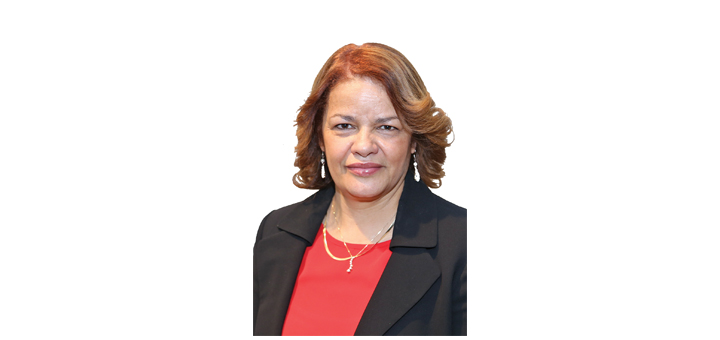
When someone asked me recently, “Why is there so much division between Black and Latino communities in Springfield?” I didn’t hear a question about race. I heard a question about power, history, and the future we want to build together.
Because the truth is this: Black and Latino residents in Springfield have far more in common than what divides us. We are communities shaped by migration, resilience, faith, culture, and generations of making a way out of no way. We are families who have survived redlining, underinvestment, and political systems that too often benefit from keeping us apart.
But we are also the communities who show up — in our schools, our churches, our small businesses, our neighborhood councils, our youth programs, our block parties, our food pantries, our arts spaces, and our streets. We are the backbone of this city.
So, the real question isn’t why division exists.
The real question is: What are we going to do about it?
The Roots of Division Are Structural — Not Personal.
When people talk about “Black vs. Latino,” they often make it sound like a cultural conflict. But the divides we see today were shaped by:
● Housing discrimination — Black and Latino families were pushed into the same under-resourced neighborhoods and then told to compete for scraps.
● Economic inequality — When jobs disappear and wages stagnate, communities are pitted against each other instead of the systems that created the scarcity.
● Political gatekeeping — When representation is limited, communities are encouraged to fight over a single seat instead of expanding the table.
● Language and cultural barriers — Not because people don’t want to connect but because institutions never invested in real access.
These are not interpersonal problems. These are policy problems. And policy problems require collective solutions.
Springfield’s Future Depends on Black–Latino Solidarity. We are a majority minority city. That is a strength — but only if we act like it.
When Black and Latino communities work together, we change outcomes. We elect leaders who reflect us. We pass budgets that invest in our neighborhoods. We demand accountability from every department. We build schools, parks, and programs that serve all our children.
Division keeps us fighting over crumbs.
Unity lets us demand the whole loaf.
And right now, with a billion dollar city budget on the table, unity is not optional. It is the only way to ensure that every neighborhood — from Indian Orchard to Mason Square to the North End to Six Corners to Forest Park — gets the resources it deserves.
What Working Together Actually Looks Like
Unity is not a slogan. It’s a practice. It looks like:
● Shared leadership — Black and Latino leaders co chairing committees, coalitions, and neighborhood initiatives.
● Language justice — Ensuring every meeting, document, and public process is accessible in English and Spanish.
● Youth collaboration — Black and Latino teens building projects together instead of being told they’re rivals.
● Cross community storytelling — Celebrating the histories, migrations, and cultures that brought us here.
● Economic partnerships — Black owned and Latino owned businesses teaming up for contracts, grants, and growth.
● Showing up for each other — Not only when tragedy strikes, but when opportunity knocks.
This is how we build a Springfield where no community has to “win” at the expense of another.
A City That Chooses Unity Chooses Power
Springfield is one of the poorest cities in Massachusetts, but we are also one of the richest in culture, talent, and possibility. The only way we unlock that possibility is together.
Black and Latino residents are not each other’s competition. We are each other’s coalition.
And if we choose unity — real unity, not the photo op kind — we can build a city where every child, every family, and every neighborhood has what it needs to thrive.
That is the Springfield I believe in.
That is the Springfield we deserve.
And that is the Springfield we can build — together. ■
Recent Stories
-
Free Summer Eats Meal Program Returns to Springfield to Keep Kids and Teens Nourished All Summer Long
With the school year having ended on June 23rd, Chartwell K12, Springfield Public Schools, and Home Grown Springfield are helping ensure that no child goes hungry this summer through the Summer Eats Free Meals Program.

Upcoming Events
[tribe_events view=”photo” tribe-bar=”false” events_per_page=”2″]
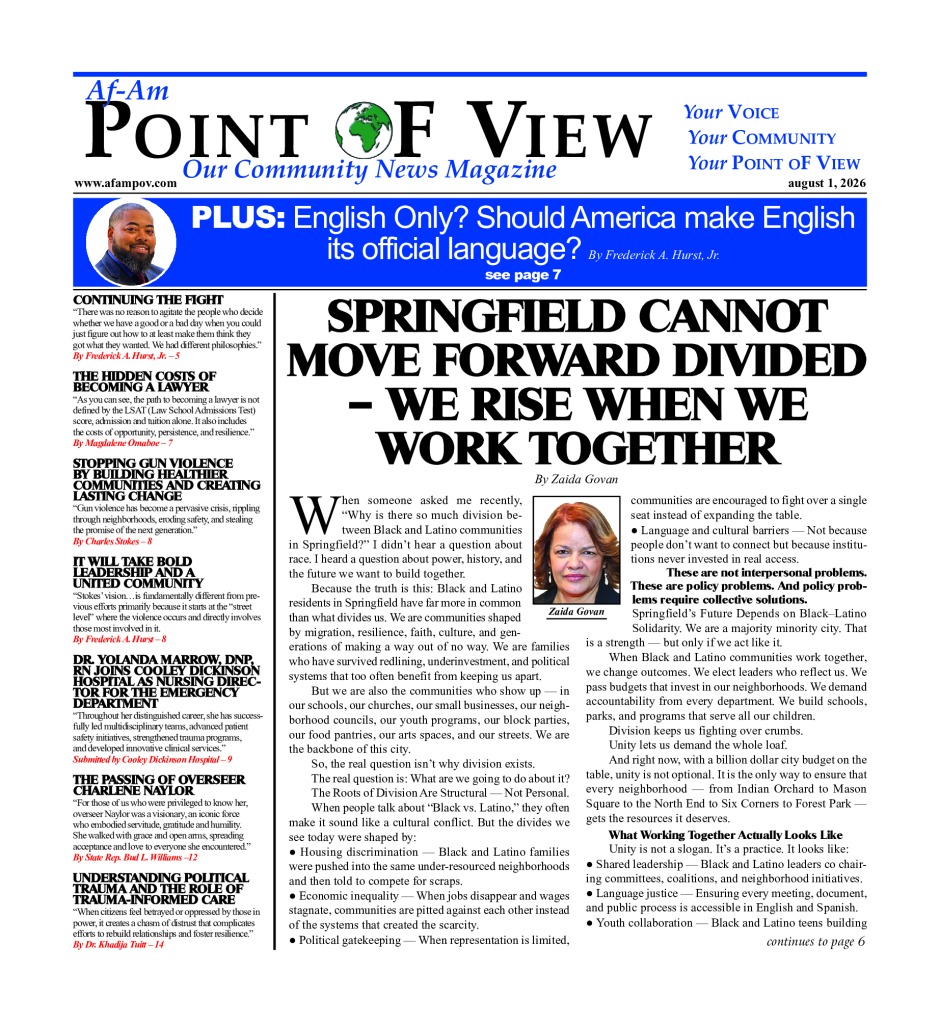
Af-Am Point of View Recent Issues
August 2026
July 2026
June 2026
May 2026
See More Past Issues of Af-Am Point of View Newsmagazine