
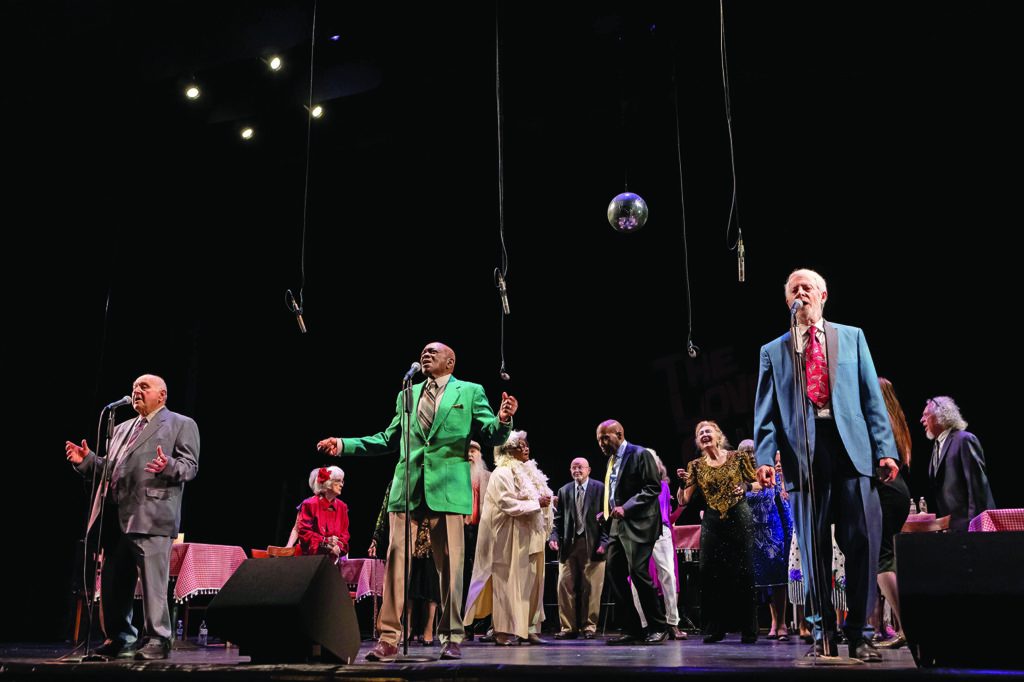
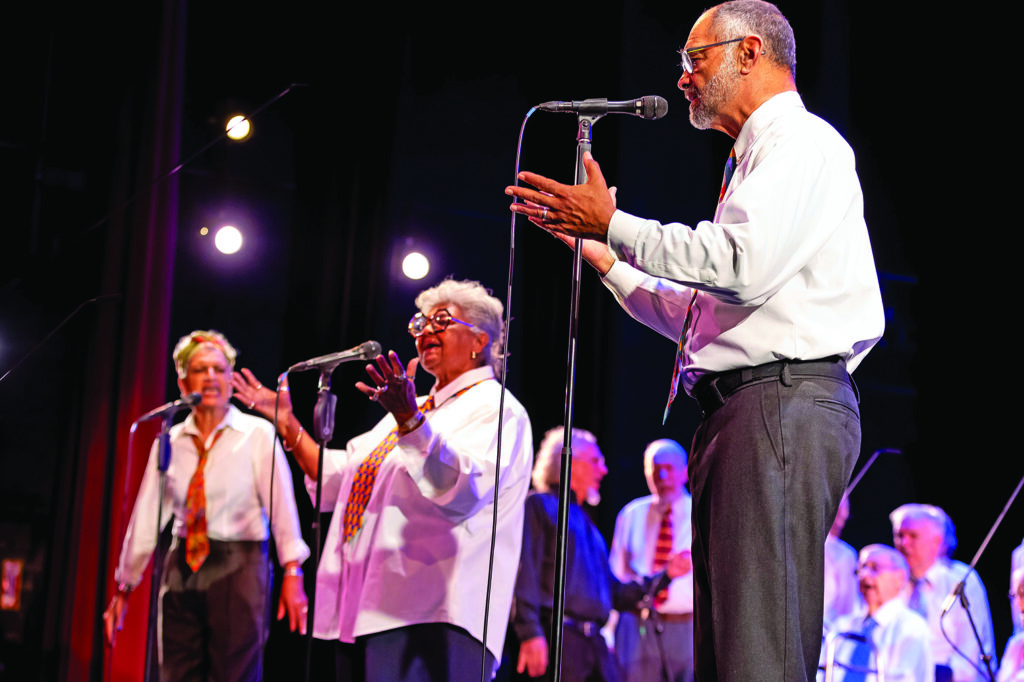
In November of 2024, I had the great pleasure of attending the production titled, “Old School,” performed by the Young@Heart Chorus (Y@H) at the Academy of Music in Northampton. Founded by its current director, Bob Cilman in 1982, Y@H has become a global sensation as ambassadors of love and the positive human connections that music and arts make possible. One cannot be a passive spectator at their performances—this was not my first. I assure you that they will awaken and infuse joy into the most weary among us as they banish discouragement, heralding what is possible as long as we have breath.
They model resistance to injustice without preaching, but by example. We experience nostalgia without sentimentality and are girded for the ongoing struggles of life—reminded that the future is the responsibility of all of us and not a burden to be unquestioningly hoisted upon the young. To remain young at heart is an act of defiance that is rooted in love. They conjure openness to new possibilities of life force at the helm of our emotions. Gently and with conviction, they lift us out of human-made muck, into forward and unified movement. It is inclusive and free of judgment inviting all to collectively and individually support each other along the way.
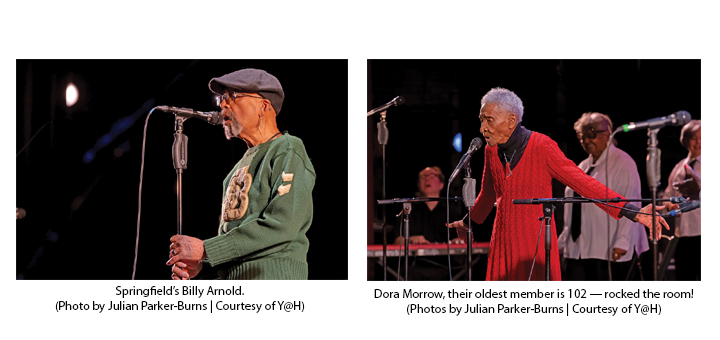
Young@Heart will be coming to Springfield’s Mass Mutual Center on Monday, January 20th, at the invitation of Martin Luther King Jr. Family Services. After attending a Y@H rehearsal at AIC, and hearing Springfield’s most beloved percussionist and friend to many, Billy Arnold, put down the drum sticks and sing, and experience 102-year-old Dora Morrow give our hearts wings with her voice and badass moves, I decided it was time to introduce this remarkable chorus to those who might not have yet had the pleasure.
Founder and Director, Bob Cilman:
MG: What can you tell us about the origins of the Young @Heart Chorus?
BC: Young@Heart was founded at a meal site for the elderly in Northampton MA. I was the meal site director, which was more like being a Maître D’. A woman named Judith Sharpe told me she could play the piano and asked me if I could get some people together for a sing along. About 25 people showed up and after about six months of getting together, we decided we should put on a show at a nearby church. About 30 people showed up. We were terrible and the audience was sleepy. Our 88-year-old stand-up comedian, Anna Main, woke them up. She went into a 15-minute routine that had them rolling. She was key to some of those first performances. When she turned 100, we decided to celebrate her with a parade in downtown Northampton. Following the press release, I received a call from her daughter who told me that Anna was lying about her age and was only 99. When I confronted Anna about this she said, “Oh damn, now I have to live another year!” which she did, and we finally had a fabulous parade downtown.
MG: You’ve been at this a long time. What about this work keeps you going?
BC: The music and the people. I love working on new songs and hearing them develop. So many members have left a huge mark on my heart and soul. Maintaining a non-profit 501c3 is tiresome, but I never tire of working with the group.
MG: When was the first time you realized that Y@H could become the global sensation that it is now?
BC: Our first overseas trip to Rotterdam the Netherlands. I didn’t think we could become anything other than lucky enough to come home alive. The production, “Road to Heaven,” directed by Roy Faudree of No Theater was a great success. Being completely unknown to the Dutch audience, the presenters struggled to get 80 people to show up for the first performance. The show was beautifully crafted and left such an impression that they sold old the next show and brought us back six months later for a three-week tour of 4 shows each in Rotterdam, Utrecht and Ghent (Belgium); all 12 shows sold out before our arrival. Over 30 European tours followed.
MG: What do you feel are the three most profound areas Y@H’s impact?
BC: The most profound impact is creating a sense of community with art. We have always seen Young@Heart as an art project and not a social service. They create something together and support each other in a way that can only happen when making art. Another impact is doing something you like near the end of your life. It isn’t easy to be a participant. It’s a lot of hard work and exercises the brain. The health aspects of being a member are enormous. For the audience, it gives a sense of hope that there is so much to look forward to in your final years. They see a racially and ethnically diverse group of people making music together. Audiences hear songs they grew up loving in a very different way.
MG: What is your most meaningful memory as director?
BC: There are too many to easily single out one. Definitely high on the list was singing in front of the King and Queen of Norway who were sitting in thrones right in front of us on stage. In back of them were 2000 people in the audience. We sang a couple of songs but the one they started boogie-ing to was a song by the Norwegian synth-pop band, a-ha, “Take On Me,” originally recorded in 1984. After the show as we were going through the receiving line to the meet the King and Queen, the King said to me, “I really loved your performance.” I said to him, “Yeah and you had pretty good seats, too.” But I believe the most memorable performance was the one that was captured in the film “Young@Heart.” It was the day we were to sing in the Hampshire County House of Correction after learning that one of our chorus members died that morning. The incarcerated men in the prison received us as warmly as any audience we had ever played for and I was literally brought to tears by the end of it.
Heather Caisse-Roberts, Development Director
MG: How does it feel working for sustainability with Young@Heart?
HC: I feel truly honored to work alongside this incredible organization, especially with Bob and Julia, as they write the next chapter for such a legacy group. This role is unique because it’s a fresh start; while Y@H has always been able to engage a supportive community, there hasn’t been a formal strategy behind development—until now.
I didn’t actually apply for this role; instead, I think we just connected quickly. Initially, I attended a rehearsal simply to learn more about Y@H and share some insights related to their new artist-in-residence partnership with AIC, where I’ve had experience as the former Executive Director of Institutional Advancement. I’d seen videos of the chorus and the Super Bowl commercial, and I was intrigued, but being there in person left me genuinely moved. My face still hurts from smiling when I think about how quickly I felt connected to the group and the mission—it was a powerful moment that made joining this journey feel absolutely right.
MG: What do you believe is the most important contribution that Y@H makes to the world—and I mean world—since you are global.
HC: Joy—plain and simple. Pure joy. They break boundaries and show that music is a universal language that can move anyone, anywhere. With every rehearsal and performance, they give it their all, embodying exactly what we hope for in true role models. The members of this chorus have lived remarkable lives, seen so much, and are still embracing life to its fullest potential. Oh, and they rock.
MG: What made you all decide to make the move to Springfield? Why now after so many years?
HC: Bob and Julia will be able to provide more detail on this as the decision was made before I began. But I can share why I think this move is so important. Springfield is a city rich with history, diversity, and heart. As a Western MA transplant, my own career and family roots have grown here. Moving Young@Heart to Springfield allows us to expand our story across a larger footprint and to truly embrace and celebrate the unique backgrounds and influences that make up this amazing area. This move is an opportunity for growth and connection. Springfield offers us the chance to reach new audiences, create new collaborations, and bring the joy and impact of Y@H to an even larger group of people. We’re here to immerse ourselves in the community, be inspired by it, and hopefully, inspire in return. This city is special, vibrant and full of stories waiting to be told. I’m excited to see how our journey unfolds here.
MG: What is your favorite part of the job? Has it had any impact on your own views on aging, as a young woman?
HC: It’s almost impossible to pick just one favorite part of this job. I get to be surrounded by music, which is one of my favorite things in life. I am becoming a part of their community and it honestly feels a bit like I am building another family full of the coolest grandparents in the world. Learning about each member of this group and their experiences makes me think about things I am not sure I would ever have reflected on otherwise. I get to help ensure that the talent and message of Y@H continues for a long time to come. As for my view on aging, while I have never been “scared” of it, now I am inspired by it.
MG: What can you tell us about the cross-generational impact that Y@H brings to its audiences?
HC: The beauty and one of the best things about Young@Heart is that it can be so intergenerational. We see younger audiences inspired by the energy, talent, and life stories of our members – especially when they hear a song they know. Everyone can feel the sense of vibrancy and purpose the chorus embodies. It’s a reminder that creativity and passion don’t have to end. It unites, it’s unique, it makes people happy.
Mark Guglielmo, Outreach Advocate (“GM” here as we share the same initials)
MG: When did you begin working with Y@H and what attracted you? Have your reasons for staying changed over the years?
GM: I started back in 2011. I’d moved to Northampton in 2007 from Brooklyn and was looking for meaningful work in this area, outside of my artistic practice. I’d seen the Young@Heart movie and it had really spoken to me. The opportunity to work with Young@Heart was exciting, as well as a really good fit. It allowed me to work in diverse capacities. When I started, they were touring a lot. Then we started focusing more locally with our PrisonVision program, rehearsing twice a week in two local prisons, while balancing everything else. Now Y@H is expanding to actively embrace singers and audiences in Holyoke and Springfield, which I am helping to facilitate, along with relaunching our prison program —all very different and meaningful initiatives. I’ve learned a lot collaborating with Bob, mastering the intricacies of non-profit artistic work and building a sustainable platform to do that work at a high level while finding ways to fund it, which informs my own capacity and work as an artist as well.
MG: What can you tell us about the work that Y@H has facilitated for the incarcerated? How did that aspect of the work begin?
GM: The first iteration began in response to the concert Y@H did back in 2006 at the Northampton men’s prison during the making of the documentary because Bob wanted to sing with the incarcerated, instead of for them. Folks living behind bars need every opportunity to feel uplifted, inspired, to expand their consciousness, to experience themselves in a new light, with a sense of community, pride in their work and belief in themselves. Basic human needs for all of us, but especially for the incarcerated, so many of whom deal with the ongoing effects of mental health issues, trauma, and poverty. Music speaks to everyone, no matter who we are or where we’ve been. In our program, we just bring the tools for making music, our experience with the musical process, and an open heart/mind. They take care of the rest. I don’t think any of them knew what they were in for. We didn’t either. We made it all up together from scratch. That’s why it worked. We didn’t really have an agenda. We co-created the program as we went with those who showed up every week. We were able to embark on a journey together that yielded some real magic, lots of fun, and occasionally some deep healing. Every few months, when we had enough good songs, we’d do a concert in the prisons with other incarcerated individuals and the prison staff. It was always a big deal. None of the singers had any real training. They just loved music and poured their heart and souls into it. The results surprised us all. They were able to take it to heights none of us anticipated. It was as if they found a channel for all the feelings they were holding inside. Unspoken words and human emotions found an outlet and safe release in the lyrics and the melodies of the songs we sang. I’ll never forget our time together. I occasionally bump into folks on the outside, sometimes years later, and it’s always a wonderful reunion. We’re in the process of relaunching our prison program. We’re not quite sure yet what it will look like this time around, but we’re all excited to get back to it.
MG: Do you feel that prison systems, at least in our state, are open to the restorative power of the arts? Why is it important to bring the arts into the prisons?
GM: I don’t really know most of the people involved in the prison system in Massachusetts. But the people that we’ve dealt with are all definitely open to the restorative power of the arts. They continue to go to bat for us and make it possible for us to do our work with their incarcerated populations in their facilities. Despite many obvious flaws in the “justice” system, there are some really good people working inside the system making a difference. It’s a difficult environment to work in. Both the old Hampshire County Sheriff Garvey and Sheriff Cahillane, who replaced him, seem to really care about the environment that is created for the men in their facility. They’ve expressed to me a genuine desire to provide the incarcerated with experiences and programs that can help them grow, heal and evolve. Both of them are big fans of our program.
MG: Does this work with Y@H in all of its aspects nurture your own creativity as a musician and visual artist? How?
GM: 100%. As an artist, I draw inspiration from all areas of my life, personally and professionally. Working with Young@Heart has fed me on many levels, both the creative and the business aspects. They go hand- in-hand. Often times, artists are good at creating but not good at business; or vice versa. For me, Young@Heart has helped me learn to do both. The art has to function at the highest level for it to make an impact. But without a well-run business, there is no structure to support the creators. I’ve worked a lot of dead-end jobs at places that didn’t inspire me in the least. It’s great to contribute something meaningful to the world and to do it with other creative people who also want to make a positive impact. Helping to facilitate venue for the presence and creative expressions of elders that challenge prevailing stereotypes of what it means to age, is a great gift and an honor. I, too, intend to create until I croak. Who better to have as a role model than the Young@Heart?
Julia van IJken, Co-Director and Content Developer
MG: You have come to us all the way from Holland — how did this come about?
JvI: I first learned about Young@Heart in April of 2020, when I was looking for choir versions of the Talking Heads song, “Road to Nowhere.” Young@Heart’s version was the first video that popped up—– and I couldn’t quite believe what I was looking at. Older people singing this song—in a way that didn’t feel gimmicky but honest and funny. I was in the middle of finishing my Master’s Degree in Experimental Communication at the Royal College of Art in London where I’d been working with research about choirs. But this was April 2020—the first few months of the pandemic. Borders were closed in Europe, stores were closed, everyone was stuck at home—and I was stuck at my parents’ house in The Netherlands (I’m half Dutch, half English, FYI). Continuing to work with choirs just wasn’t an option. Or so I thought. When I came across Y@H’s YouTube channel, I realized they were getting together and rehearsing on Zoom. It presented an exciting opportunity—I could work with people on the other side of the world, and create some powerful work within the very strict limitations and scary first days of the early pandemic. I sent Bob an email proposing a collaboration and heard back from him the next day. We ended up producing six virtual shows between 2020 and 2021. And then in early 2022, I moved to the US to join Y@H in person!
MG: What do you feel are the most meaningful aspects of your work with Y@H, both personally and for your audiences?
JvI: When people first hear about Y@H, they often think this is a cutesy thing—some sort of therapy or activity group to keep the elderly entertained. But this is not therapy and this is not a cute gimmick—this is an ambitious art project involving many different people. From the six professional musicians in our excellent band to approximately 25 chorus members, many of whom only started singing when they joined our chorus later in life. The current average age is around 86, and our oldest member (Dora Morrow) is 102 and is still an amazing singer and dancer. Working with this group for the last four years has shown me how much this work impacts the lives of everyone around it. Working together to create powerful and beautiful work does have a therapeutic impact on people, even if it’s not done with the intention of it being therapy. Making art together is really meaningful, and being considered a valuable part of a group and having a sense of community (especially later in life when that disappears for a lot of people) is clearly so important.
As an artist I love seeing ideas come to life in rehearsal and on stage. From choosing a song for a specific soloist and seeing how they commit to learning that song and making it their own, even when the material is often challenging and unfamiliar to them. Pushing them to do their very best and yet being compassionate and supportive when the process gets hard, and then seeing them pull it off on stage—with or without hiccups. Our shows include a lot of hiccups and they’re often a magical part of it all. With the help of our amazing band, we manage to freestyle around small mishaps and sometimes they turn into the best improvised moments.
Ageism is rampant in the western world. The older people are, the more disposable they often become in our society, and the more we hide them away. For Y@H, aging is quite the opposite. We put elders in the spotlight, without hiding that they’re aging, polishing things or pretending it’s anything other than what it is. I think that touches people quite deeply. The thing we all share is that if you’re alive, you’re aging. And I feel ageism is two-fold these days; we’re ageist towards older people, and towards our own ageing process. And Y@H shows people that aging is a fact of life, and it’s okay, and you could even become a rock star after the age of 80 and tour the world—and that you’re not alone. But it’s the humanity above all that’s so meaningful to me in this work. To have chorus members thank me for keeping them sane and alive (their words, not mine), and hearing from audiences that our shows feel like tonic for the soul. I could keep going on but I will stop there.
MG: How are you feeling about the move to also working in Springfield? What are you and the team doing to reach new audiences?
JvI: The move to Springfield feels really good and so important. This work started in Hampshire County in 1982 and for a long time Y@H mostly served the communities of Hampshire County. But our membership has branched out a lot in the last 40 years, and we now have quite a lot of members in the Springfield area. In order to really be equitable as an organization, we needed to rehearse in locations close to where many of our members live. For some of them that means Florence, where we rehearse on Mondays, and for some of them that means Springfield, where we rehearse on Thursdays. This way it’s a longer ride for some people on Mondays, and for others it’s a longer ride on Thursdays. And this makes it easier for people in Hampden County to join Y@H since we rehearse close to home.
In 2024, we did an amazing collaborative performance with the Children’s Choir of Springfield, and we have started a partnership with Dr. Martin Luther King Jr. Family Services, who have invited Y@H to perform as part of the Dr. Martin Luther King Day celebration at the MassMutual Center on Monday January 20th this year. We’re very excited about that. We’ve also had multiple members of our chorus join Marco Dermith on his STCC radio show, Ecos del Ritmo, to talk about Y@H, and we are in the process of setting up performances in Springfield for 2025, including some smaller pop-up performances at community centers and senior centers to introduce Y@H to older folks living in Springfield. So many people in Springfield don’t know about us yet, so we’re starting with building connections with community leaders and organizations and introducing Y@H to everyone.
MG: What are your feelings about the role of intercultural, multi-generational work in society?
JvI: In order to build an equitable and sustainable present and future, we need to understand our intercultural histories and how those histories have impacted and continue to impact the world. But it’s not just about history—I really believe that as a performing arts group, we should represent the diversity of the world we live in, be as inclusive as possible, and that we need to work hard to fight marginalization.
Some of the strongest work we’ve done has been in collaboration with children’s choirs. Something really magical can happen when an 8-year-old and an 80-year-old sing together. Music is one of the most powerful tools to create unity and deeper understanding. We make sure to keep our repertoire as diverse as possible in regards to who has written the music we’re working with—it’s important to sing words from a varied group of hands, and to sing in languages that represent the members of our group. We mostly sing in English and Spanish, and when the group tours abroad, we make sure to learn songs from the country we’re visiting and in their language.
MG: Are you currently holding auditions?
JvL: Always! Reach out to Bob if you are 75 or older. We rehearse twice a week. All languages welcome. We have sung in multiple languages—and the primary languages we sing in at this time are English and Spanish.
To learn more: www.youngatheartchorus.com, Please also follow us on Instagram/Facebook (@youngatheartchorus) To support: Heather Caisse Roberts  dev@youngatheartchorus.com
For auditions, partnerships and booking: Bob Cilman info@youngatheartchorus.com or Julia van IJken content@youngatheartchorus.com  ■