As you may recall from reading Part I in the February issue of Point of View, Curtis Johnson was seven years old when his mother died of a sudden illness just seven days after the family moved into his mother’s dream house that his father purchased for her on Westford Avenue in Springfield.
Curtis, the youngest of the six kids born to Ozzie Mae Johnson and Sanford Johnson, did not take the sudden loss of his mother well. His reaction was to misbehave in school which included resorting to violence against fellow students. To complicate matters, Curtis’ father owned an autobody business that required him to travel a lot so he sold his Westford Avenue home and arranged for Curtis to stay with various relatives in different parts of the country which meant that Curtis attended many different schools from the time he was seven to the time he finally graduated from Englewood High School in Jacksonville, Florida in 1985.
It was an unsettling lifestyle for a youngster but Curtis weathered his circumstances relatively well. He eventually channeled his repressed anger over his mother’s death into a more organized form of violence. Sports.
While attending Robert E. Lee middle school in the 7th grade in Orlando, Florida and Madeira Beach middle school in the 8th grade in St. Petersburg, Florida, he joined their football teams and won county championships as a light heavy weight wrestler. In the 9th grade, after living with his cousin in Pittsburg, Pennsylvania where he learned how to box, Curtis was allowed to live with his good friend’s family in New London, Connecticut where he flourished in football on the varsity team and basketball on the junior varsity team. And when Curtis graduated from Englewood High School, where he was living with his father, he made the National Honor Society, was sports editor of the school newspaper, and graduated with a full football scholarship to Bethune Cookman College.
To the unknowing observer, it seemed that Curtis was headed for a stable and successful life. But unresolved issues (relating to his mother’s death and the drowning death of his seventeen-month-old daughter who was born in his last year of high school) that were simmering below the surface of his life and which didn’t fully manifest themselves until he joined the Army, where he starred on its semi-pro football team while his lifestyle began to deteriorate. And after he was honorably discharged and away from Army discipline and formal sports, those unresolved issues eventually landed him in prison. (For more details, read Part I in our February issue.) This article is about what happened to Curtis when he was sent to prison and how he eventually turned his life around and dedicated himself to a life of service.
The first time I met Curtis Johnson was when he came to my office in response to an appointment we set up by phone for an in-person interview. He had been recommended to me as a person of interest who I might want to write about. Needless to say, it soon became clear to me that his story needed to be told. It was inspirational and a perfect example of perseverance of the type so typical of the Black experience in America.
All I could think of as I listened to Curtis’ story is that, “All the system could come up with to handle this brilliant, well-educated, sensitive, honest, once-broken Black man, who had served his country honorably, was to incarcerate him. And, in the end, he had to find the strength to heal himself, which some others have done but which so many simply could not find the strength to do.”
But, even worse, the resulting criminal record that clings to most former inmates like a scarlet letter makes it almost impossible to earn a decent living and almost guarantees that many will see little alternative than to revert to their unlawful ways. But Curtis Johnson took a different and somewhat unique approach both to incarceration and to life afterwards. And to say that he is living a blessed life is putting it mildly.
Around 1994, Curtis began serving a twenty-eight-month sentence at Carl Robinson Correctional Prison in Enfield, Connecticut. It was the beginning of his religious conversion to Islam. He briefly had been introduced to the Muslim religion in college but in prison, he submerged himself in it and became a leader. He went to classes, ordered tapes and books and learned to read and speak Arabic.
He also began practicing a way of life that would guide him after prison. He never joined a gang in prison. Instead, he became a leader and a mentor to the younger inmates and lent a hand to older inmates who had been in prison for years. He ran sports programs, served on a special committee that did outreach to the outside community for inmate assistance and he joined the American Vets in Prison organization which he supports to this day.
When Curtis left prison in 1996 for Orlando, Florida, he built on his new way of life. A friend asked him to give him a hand to help in tackling drills for a football team he was coaching. When Curtis arrived at practice, his coach friend didn’t show up so Curtis ran the football practice. When Curtis learned the coach was sick and missing subsequent practices, he took over his first formal coaching responsibility and coached 7th and 8th grade football for 2 ½ years.
In 1999, Curtis returned to Springfield to visit his brother and put flowers on his mother’s grave and after reporting to Mosque 14 in Hartford, Connecticut, he moved to Springfield and joined Mosque 13 under Springfield’s inimitable and outspoken Imam, Yusuf Muhammad. Curtis eventually moved to Masjid Al Baqi Islamic Center, a Sunni Muslim Mosque, on the corner of Union and Oak Streets, where he remained until a couple of youthful arsonists burned it down−after which he took a respite from organized religion and devoted his time to such things as yoga, meditation and reading of self-help books and the like…anything to gain peace of mind−until he met Reverend Dr. Howard John Wesley, the former pastor of the historic St. John’s Congregational Church located on the corner of Union and Hancock Streets.
Reverend Wesley was a special kind of person. He came to St. John’s straight out of seminary school in Boston. I remember when he was hired by the elders of the church when the church was a skeleton of what it had been until Wesley arrived and altered its culture, which, to put it gently, was considered elitist, which is why its congregation shrunk as the old guard died out. I remember this because the late Dr. Jesse Parks, one of the elders and a good friend, came to me and told me about the young, dynamic minister they had just hired. He knew my history and wanted me to visit St. John’s to hear Wesley preach which I declined to do having had enough negative experiences to have soured on organized religion.
I eventually joined St. John’s but only after Wesley was close to leaving and after he had grown St. John’s into the mega-church of Black Springfield at a time when every one of the larger churches in Springfield were in precipitous decline. Some blamed Wesley for raiding their memberships but the truth is, Wesley came with a message that attracted people like Curtis Johnson, who responded to Wesley’s invitation to visit St. John’s and stayed for eight years as a participating member and an “armor bearer,” a fancy name for the security ministry, which is similar to the role he played while a practicing Muslim.
But the fact is that Curtis’ true ministry was youth sports and the mentoring that came along with it. And although he has shied away from organized religion, coaching football while mentoring young people is something he says he “will do until the Lord says otherwise.”
And, coach he did.
When Curtis arrived in Springfield in 1999, he volunteered to coach the 5A Hawkeyes at Brookings Elementary School. In 2001, while coaching the 5A Hawkeyes, he became the offensive line coach at New Britain, Connecticut High School, driving back and forth between the practices and games of the two teams. At the time, he was working as a machinist for Titeflex during the day and for the Springfield YMCA at night as a fitness trainer. At first, about three Springfield High School of Commerce student athletes joined his fitness classes. Eventually, the number jumped to about 15 and then to 40 or more during which time Curtis formalized his YMCA youth fitness program. One day Mike Martin, Springfield’s Athletic Director, happened by and was so impressed by what he saw that he offered Curtis a job coaching football at Commerce where Curtis coached from 2002 to 2008, winning championships in football and basketball, which he also coached at Commerce from 2004 to 2008.
After a few seasons off, Curtis served as assistant coach at Everett High in Everett, Massachusetts for two years and helped coach the Madison High School basketball team in Roxbury while working for the YMCA as youth sports program coordinator from 2011 to 2015.
In 2015, Curtis returned to Springfield where he coached AAU basketball for the Dunbar Community Center for its director and now city councilor, Levar Click-Bruce. In 2016, he developed the Baystate Academy football team and coached the junior high team. In 2017, he left Springfield for Annapolis, Maryland Christian School where he coached the basketball team and served as defensive coach for the football team where he won three championships.
In 2019, Curtis returned to Springfield Commerce High as head coach when local politics and his record from more than 20 years past collided and after 10 months on the job, he was terminated. To this day, Curtis believes the entire Commerce affair was political and had nothing to do with his past record since he had always made his past known up front.
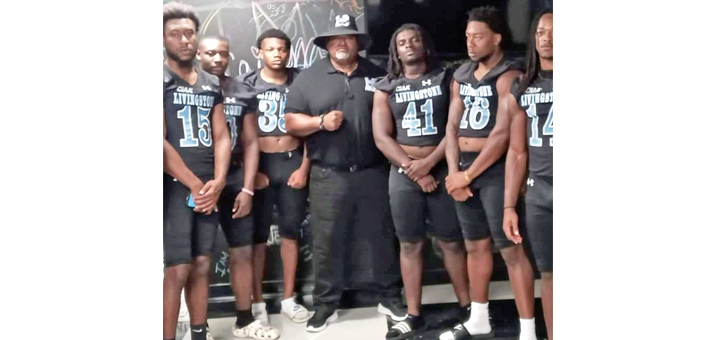
Undaunted and always in demand, Curtis returned to Maryland and was hired as head football coach at Livingston College, an HBCU, where he completed a 2 ½ year contract before recently returning to Springfield to take a job at ROCA as a Youth Violence Outreach Prevention Specialist providing service and treatment and counseling to 16-24 year-old trauma victims through a collaborative program sponsored by Baystate Hospital called “Better Tomorrow.” Needless to say, Curtis continues to coach teams in Hartford and Western Massachusetts and, in fact, was on his way to a game in Hartford after consulting with me on this article.
I know that I haven’t included everything about Curtis Johnson that there is to tell. His life is a book that only he could write about and give full justice to. There are so many small parts of his story that only he can tell. For instance, what he told me about how some adults and fellow coaches, hearing him speak loudly to his players, expressed concern that he is being too strict. They don’t know that Curtis is a disabled veteran with a hearing problem brought on by his eight years serving in the Army mostly in an artillery unit. His loud speech is partially a reflection of his disability although I’ve never known a loud coaching voice to stifle the development of young people of the type he coaches and mentors.
Solomon Baymon is one example that stands out. Curtis coached and mentored Baymon through high school and helped him to become the man he is today. And today, Baymon is Curtis’ supervisor at ROCA and he never lets people forget the debt he owes to Curtis Johnson. And Baymon is only one of thousands of young lives that Curtis has nurtured to adulthood who otherwise might have been diverted to jail and prison.
What Curtis said to me is, “I wanted to be for young people what I needed when I was coming up.”
I can say this without qualification. I can think of no better coach that I would have wanted my sons to be under when they played football in high school. And, the same goes for my grandsons, one of whom is currently playing football and the other of whom soon may follow.
On any day, give me the guy with the loud voice and the good heart and the proven character who possesses the perseverance to overcome his own obstacles in life and the commitment to pass his lessons learned down to the young.
Give me Curtis Johnson. ■