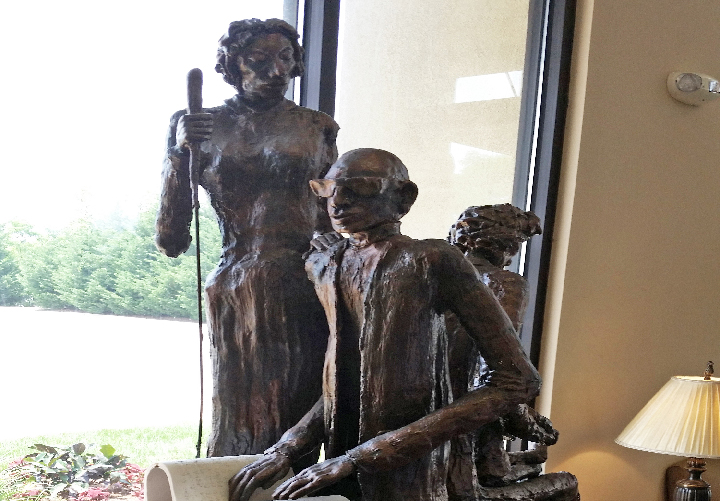

The statue in the lobby was commissioned by BISM in celebration of its 100th Anniversary. It embodies what the Rehabilitation Prog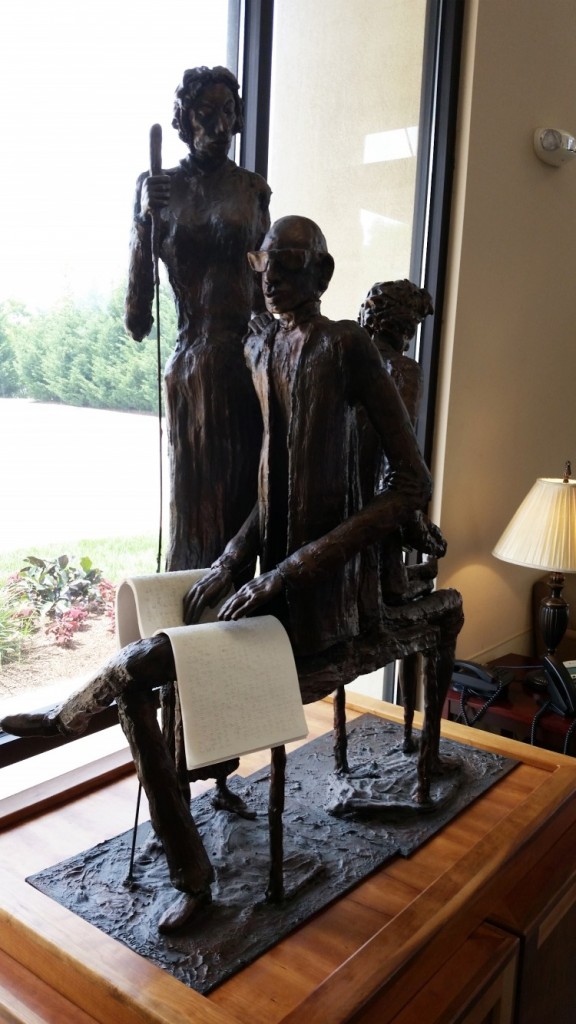 ram at BISM does, which is to teach blind children, adults and seniors to accomplish more than they thought possible. In this particular statue, Phillip focuses on the power of Literacy and the use of Braille to read. The interpretation is twofold: One half of the statue shows a blind mentor teaching Braille to a blind senior adult. The other side shows a blind parent reading a story in Braille to her sighted child. The child follows along in Braille and in the printed picture. Both halves are then put together simultaneously showing the benefit to both senior and child in reading Braille, making the point that it is never too late, or too soon to learn to read Braille.
WHERE THE BLIND SEE
By Frederick A. Hurst
Our late April, 18-day trip to Southeast Asia (Vietnam, Cambodia and Thailand) involved 10 (thankfully) uneventful airplane flights. And in May we had two more uneventful airplane flights to my brother’s wedding in Houston, Texas and back. I was scheduled for a trip to Baltimore in June to visit a facility where blind people learned to be independent and employable in a program that I felt could be instructive for those who wonder how to break the cycle of poverty in our inner cities.
Not wanting to press my luck so soon with another flight risk, I purchased a train ticket. As luck would have it, right after I purchased my ticket but before my boarding date, an Amtrak train, following my same planned route, derailed after it approached a 50 mile per hour curve at more than 100 miles an hour, killing and maiming many passengers. Needless to say, my Amtrak comfort level declined.
My own train trip to Baltimore was uneventful. But on the trip back, the train’s engine broke down in Hartford, Connecticut at 10:00 at night and I ended up stranded. After waiting for nearly an hour, it became clear that no replacement engine would be forthcoming within any reasonable time and the railroad was not offering an alternative. So I called home to Springfield for a ride and finally arrived home close to 1 a.m. (at least two and one half hours past my scheduled arrival time) perturbed and generally tired of traveling but less inclined to spurn the well-proven, relative safety and security of air travel.
But I also returned home enlightened about “Blind Industries and Services of Maryland (BISM).” I was introduced to BISM by one of our Asia traveling companions, Fred (Frederick J.) Puente. While engaged in casual conversation, the subject arose about a unique business that champions the blind where the unassuming Fred serves as President and Chief Executive Officer. I was intrigued by what he described because it sounded to me like a replicable prescription for lifting people out of poverty. So I gladly accepted his invitation to visit his Baltimore operation, which is one of many facilities around the country that BISM operates for the benefit of the blind.
Invalid Displayed Gallery
BISM is a $100 million, quasi public, 501(c)(3), service, manufacturing and sales enterprise whose more than 500 substantially blind employees produce a range of goods and services for state and federal agencies and the private sector that compete in quality and price with organizations that do not employ the blind. My visit to BISM showed me how, if encouraged and provided with the right opportunities to learn, people who are blind can generate their own income and be as independent, productive and competitive as those who are not blind, which is what piqued my curiosity when Fred Puente first described it to me across the table while we were enjoying a quiet meal on a river cruise down the Mekong River.
While Fred was describing BISM, my mind raced back in time to the massive, multi-billion dollar, failed government programs designed to implement President Lyndon Johnson’s 1965 declaration of “war on poverty.” Programs like the Model Cities program, Concentrated Employment Program (CEP) and the 1973 (scandalous as it turned out) Comprehensive Employment and Training Act (CETA) that proved mostly wasteful and didn’t last primarily because they weren’t sufficiently designed for longevity or, for that matter, effectiveness. Though Johnson may have intended for them to eradicate poverty, it has always been my opinion, and that of many others, that the bureaucrats designed them more as riot suppressors and pacification programs and, of course, political patronage havens. And even though most such programs can be credited with leaving behind some valuable residual gains, they were never intended to generate income, wealth and independence, which is what distinguishes all of them from BISM which, from my observations and research, could have been a successful model for all of them.
BISM was created in 1908 by the Maryland General Assembly as “Maryland Workshop for the Blind.” It was created by caring people who realized that the blind people of Maryland, as in most of the country, were a neglected and underutilized asset. The legislation included provisions to “provide vocational rehabilitation, continuous employment and other resources (emphasis added) to blind adults of Maryland.” Maryland Workshop for the Blind was later converted to a 501(c) (3) nonprofit with a board appointed by the governor. In 1973, it was renamed Blind Industries and Services of Maryland.
Though the fundamental concept of BISM has remained as it was conceived, its conceptual foundation, as should be expected, has been expanded and refined over the years. The legislation that created BISM required that Blind clients be trained to produce products that would be given preference for sale to state agencies as long as they were competitive in price, quality and timeliness. For many years BISM products were simple: straw brooms, mops and even smaller items. But that was destined to change with improved technology and the formation of the National Industries for the Blind.
The National Industries for the Blind (NIB) was formed in 1938 after Congress passed the Wagner-O’Day Act which was the brainchild of two men who were blind, Peter J. Salmon and Robert B. Irwins, and one who was not, Moses C. Migel, who was a philanthropist and powerful businessman who was also president of the American Federation of the Blind. The three shared a desire to grow meaningful jobs for the blind and liberate them from the widely held notion that their blindness rendered them unproductive. These pioneers worked together, with the assistance of the famous Helen Keller, to influence passage of the Wagner-O’Day Act after which the three, with the assistance of other interested parties, established the nonprofit NIB to implement the Act with Salmon as its first chairman.
NIB was explicitly intended to provide “an opportunity for nonprofit agencies employing people who were blind to provide the federal government with products, as long as those organizations were able to deliver them on time, to strict specifications and at a fair market price (emphasis added).” Its organizational structure is simple but powerful. NIB serves as the central agency through which federal government orders flow for distribution to nonprofit “affiliates” around the country. And NIB is substantially financed by fees paid by its affiliates as a percentage of their profits.
With the power of its finances, the NIB eventually evolved to also become the prime research arm for the development of techniques and training for affiliates to provide through mostly blind workers an ever expanding variety of products for sale to government and private enterprises. And its many affiliates throughout the country are spared the large cost and effort of research and development while focusing their efforts on the production and sales that would produce the income that would finance employment and training and a variety of other services for the blind. The combination evolved to become a unique, interactive, free enterprise model whose design, with modification, could easily have been replicated to make President Johnson’s war on poverty programs more likely to succeed, and it was readily available. BISM became an affiliate of NIB about 60 years ago which made it both a state and federal supplier. Up through the mid 1980s it expanded its geographical reach and its level of production throughout Maryland to include more sophisticated equipment and a broader base of products. It was growing steadily though too slowly, and I think it is fair to say, and statistics overwhelmingly affirm, that it was not until Fred Puente came along that BISM blossomed into the economic powerhouse it is today.
Maryland’s governor appointed Fred to the Board of Trustees of BISM in 1987. In 1993, the Board elected him as BISM’s President and Chief Executive Officer. At the time, BISM sales totaled $7.1 million and it had 87 “associates.” Today sales are approaching $100 million and BISM has 500 “associates.” And, though he probably would prefer that I not say it, most of the credit for the expansion goes to Fred Puente.
Fred is a big White guy with an affable personality who has a compassion for people that was very much influenced by his reaction to the tension his father lived with in his life-long, union-related job. He is a people person and a visionary with a nonstop creative mind. As he walked me through the Baltimore facility, he joked with folks and called everybody, from machine operators to the management staff, by their first names and they responded with affection and later, to a person, made it clear to me that the BISM work environment was special and relaxed, which is exactly how Fred told me he wanted it to be. In fact, everybody at BISM is considered an “associate” rather than a worker or an employee, including Fred Puente. The term reflects BISM’s philosophy of cooperation, inclusion and respect for the value of each individual.
Fred hires good people like Guy DeRossi with whom I collaborated to write this article. Guy is also a fellow Asia traveler. He and Fred interact more like brothers who get along, even though neither pulls any punches when candor is needed. Guy spent 20 years as Vice President of Finance and Administration at NIB before coming to BlSM as Senior Director. Guy had some heavy personal losses as a youngster and had every excuse at his disposal to fail in life but refused to. His compassion matches Fred’s which speaks well for his character to which his lovely wife, Mary Ann, is also a fitting testimony.
Fred’s wife, Marcia, by the way, is a jewel, too. She gave Fred a gift for me which I opened in the car when Fred and Guy picked me up at the Baltimore train station. It included a touching card that recorded in poetry many of our past travels and reflected the closeness that has grown among us. Frankly, had we not developed that closeness, I probably would not have accepted the invitation to Baltimore and would have missed a valuable experience.
The Maryland part of BISM’s title is really a misnomer since it has 14 facilities around the country, including manufacturing operations that produce over 150 products in Baltimore, Cumberland and Salisbury, Maryland and North Carolina and eight “Base Supply Centers” in Maryland, Delaware, Kentucky, North Carolina, Virginia and Washington, D.C. where BISM has joined other NIB affiliates in replacing military base stores (commissaries). The Base Supply Centers, which are supplemented by the 50,000 items made available on the BISM website, not only provide a one-stop shopping center for military personnel but they also employ mostly blind or partly blind BISM personnel and they provide a lucrative market for the goods and service that BISM manufactures. (The opportunities to open base supply centers arose when the government decided to exit many locations)
If there was more room for it, I would never end this article because BISM has accomplished so much more than I can capture here. Through its Rehabilitation and Training Division, BISM also provides free classes for the blind in Braille, Cane Travel, Independent Living, Computer Technology and Adjustment to Blindness Seminars as well as a special program for senior citizens who have lost their sight and need a boost in their skills and confidence to continue living a meaningful existence. And they have a rehabilitation and fitness program complete with state of the art gym equipment. They also have a summer residential program for blind youth which is designed to give them the “confidence and work experience to successfully transition into high school, college and/or employment.” These programs are made available to the blind throughout the state of Maryland and are paid for by BISM mostly out of profits from the sale of its products.
And I would be remiss not to elaborate on the aforementioned North Carolina plant that resulted from one of BISM’s many partnerships. It started out as an agreement with the Raleigh Lions Club Clinic for the Blind whereby BISM would manage their textile cutting division and culminated with BISM buying them out and moving the entire manufacturing operation into a new building which is now known as the Raleigh Division of Blind Industries of Maryland. Also worth a special mention is the Salisbury plant which started small and grew into a large producer of military uniforms. And BISM has its own marketing, accounting and graphics departments as well as its own dining services. And, the blind are a major part of running everything while being paid competitive wages with unlimited sick time that is not being abused because people love working at BISM which they consider their own!
How appropriate! What better way to help folks in need than to help them to help themselves. What a simple, powerful age-old idea! To see the awesome machines that blind people are using to cut fabrics to design specifications and packaging for shipment to customers, and the water purification and manufacturing facility that produces bottled water in five gallon containers, down to the small drinks we buy at the store, and to label them with material developed by their own graphics department, and to watch blind workers make office supplies on machines that produce products that are marketed under the SKILCRAFT symbol (By the way, when you buy products with that symbol, the blind will benefit.) to state and federal government agencies and commercial customers like Staples and so much more, takes one’s breath away at the potential for replication and good. They even have a facility for mixing dangerous chemicals for producing janitorial supplies for sale. Wouldn’t it be great if the state and federal governments combined with nonprofits to put inner city folks to work building their own communities under similarly modeled programs?
Fred reminds me a lot of Roger Williams, our former local Civil Rights pioneer who ran the Concentrated Employment Program out of Buckingham Jr. High School beginning in 1968. I worked for Roger under a subcontract with the Springfield Urban League. Even back then, as I watched Roger struggle to comply with federal guidelines, I had a sense of dread that we meant well in what we were doing but that something wasn’t right in how we were doing it. I often asked him why we didn’t invest all that money pouring into the program into a profit making venture. I suggested the same to my brother who was chairman of Springfield’s Model Cities program. Maybe it was because, when so many folks were moving into Black Studies majors and vague Liberal Arts majors, I chose Economics and Business, which probably gave me a different perspective on what permanent progress for poor people should look like.
But the fact is my brother and Roger didn’t make the rules that the bureaucrats held them to. And after all, as long as the money flowed and the people were satisfied (if only for the moment) and the politicians satiated, why stop a good thing? Well, in the final analysis, when control of federal government funds reverted away from the community and back into the control of city hall, it proved not to be such a good thing. Model Cities died first. And then CEP and CETA, followed by a string of lesser community controlled programs. And what remained were many tiny, struggling community agencies competing among themselves for a trickle of money that stingy local powers allocated all too sparingly and with minimal effect.
And the result is poverty at levels exceeding those which these defective programs were designed to eliminate. And poor neighborhoods ended up devastated by drugs, violence, crime and hopelessness and saddled with a political class that altogether too often is more satisfied to chum for scarce crumbs than to demand concrete programs that liberate like BISM― the same political class that grew out of and promoted the defective Johnson-era model that probably could not have existed without them. And so it should be no surprise to anyone that the urban riots we thought were behind us have returned.
BISM, which is thoroughly integrated by the way, is about simple economics and business combined with a compassion for freeing up human potential. It is a quintessential example of the parable about giving people fish. If, instead, you teach them how to fish, they will be liberated. BISM is an excellent program for the blind and a good model for anybody in or out of government who is contemplating restarting the effort to raise people up from poverty.
(Must read: Empowering People, The Story of National Industries for the Blind and its Associated Agencies by Mary Jane Surrago)■
Read this month’s featured article: WHERE THE BLIND SEE